Best Practices
How to Get Real Estate Leads for Free: 21 Strategies That Actually Work
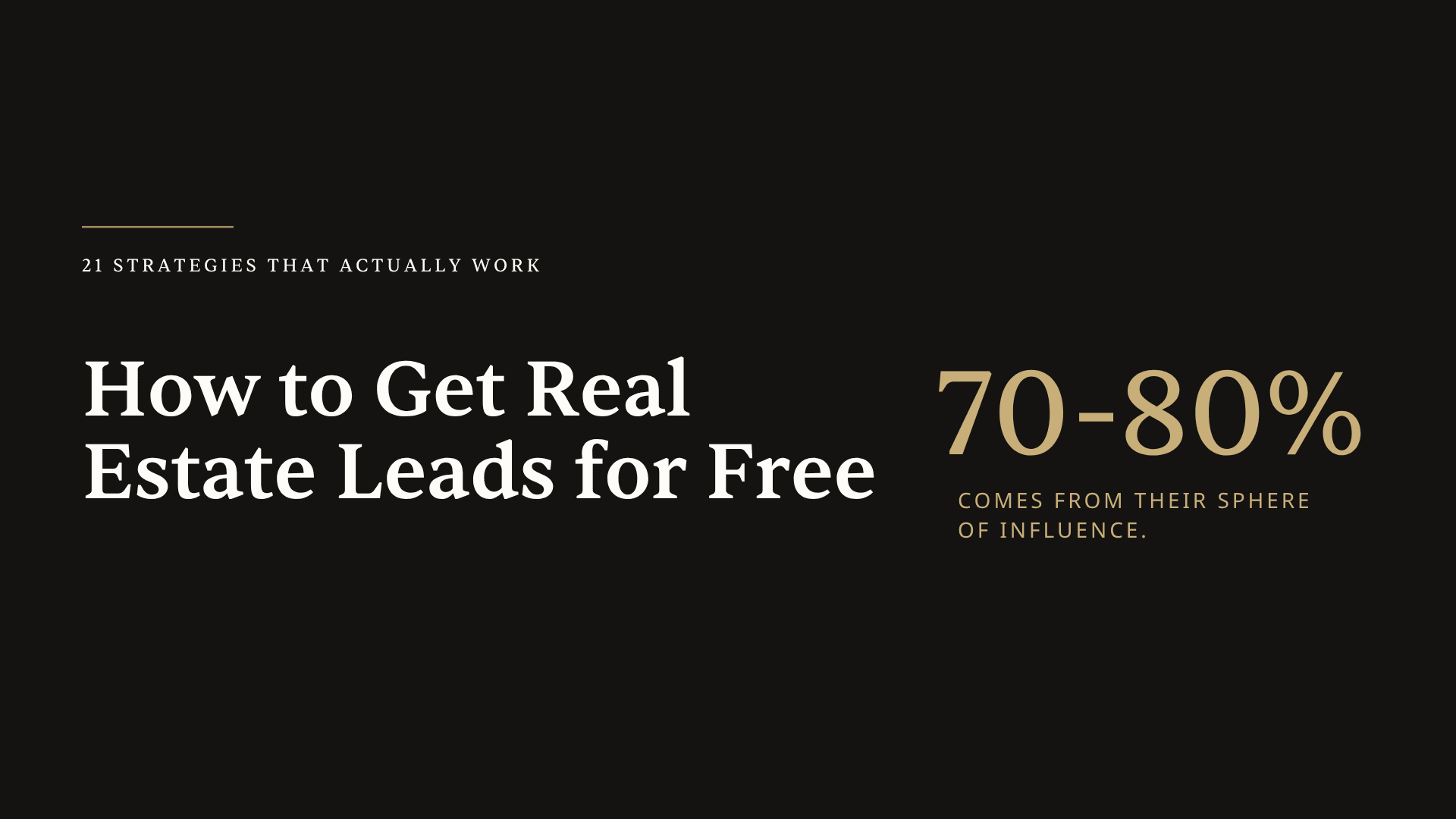
How do the agents closing 30+ deals a year keep their pipeline full without spending $400 per lead on Zillow?
Here's what the data says: 43% of buyers and 66% of sellers find their agent through referrals or past experience, not paid ads. The average paid real estate lead costs $416 to $480, and in metro markets like New York or San Francisco, that number jumps to $200 to $350 per lead before you even know if they're serious. Meanwhile, the agents who consistently rank in the top 10% of producers convert leads at 3x the industry average, and most of their business comes from sources that cost exactly zero dollars.
This guide gives you 21 free lead generation strategies ranked by what actually works, backed by conversion data and real numbers. Plus, we'll cover the one strategy nobody talks about that generates 70-80% of business for experienced agents.
The Real Cost of Real Estate Leads in 2026
Before you invest time in free strategies, it helps to understand what you're saving. Here's what agents are paying for leads right now:
| Lead Source | Cost Per Lead | Conversion Rate |
|---|---|---|
| Zillow | $20-$60 | 1-2% |
| Realtor.com | $25-$45 | 1-3% |
| Facebook Ads | $5-$25 | 1-2% |
| Google PPC | $30-$50 | 2-4% |
| Referrals | $0 | 15-25% |
The math is pretty straightforward. If you're paying $50 per Zillow lead with a 2% conversion rate, you need 50 leads ($2,500) to close one deal. Compare that to referrals, which cost nothing and convert at 10-15x the rate of paid leads.
That said, 46% of agents spend $0 to $250 per month on lead generation. You don't need a massive budget to build a real pipeline. You need the right mix of strategies and the discipline to work them consistently.
10 Free Online Lead Generation Strategies
1. Optimize Your Google Business Profile
This is the lowest-hanging fruit in real estate. Your Google Business Profile shows up in local "map pack" results when someone searches "real estate agent near me" or "[city] realtor." It's completely free and takes about an hour to optimize properly.
What to do: complete every field, add photos of your listings monthly, post weekly updates about market activity, and actively ask happy clients for reviews. Agents with 50+ reviews consistently outrank those with fewer, regardless of how long they've been in business.
2. Start a Hyperlocal Blog
Content marketing generates leads at $15 to $50 per lead through organic search, but the real value is compounding. A blog post about "[Your City] first-time homebuyer guide" can generate leads for years after you write it.
Focus on topics with local intent: neighborhood guides, school district comparisons, market updates, and answers to questions your clients actually ask. One blog post per week, consistently published for six months, typically starts generating organic traffic.
3. Leverage Video Content
Video gets 403% more inquiries than text-and-image posts combined. And video posts get shared 1,200% more than other content formats. You don't need professional equipment. Your phone, natural lighting, and genuine knowledge about your market are enough.
Film neighborhood walkthroughs, listing tours, market update explainers, and "day in the life" content. Post on YouTube (which is also a search engine), Instagram Reels, and TikTok. The agents who show up consistently on video become the recognized experts in their market.
4. Build Your Presence on Nextdoor and Local Facebook Groups
Nextdoor and neighborhood Facebook groups are where your future clients already hang out. The key is providing value without being salesy. Answer real estate questions when they come up. Share relevant market data. Be the helpful neighbor who happens to be a real estate expert.
When someone posts "thinking about selling, any agent recommendations?" in a group with 5,000 members, the agents who've been consistently helpful get tagged by other members. That's a warm lead without spending a penny.
5. Collect and Showcase Reviews
Reviews are the new referrals. 88% of home buyers purchase through an agent or broker, and most of them check online reviews before picking one. Ask every client for a review on Google, Zillow, and Facebook within a week of closing.
Here's the thing most agents miss: 71% of buyers contact only one agent, and 81% of sellers work with the first agent they reach out to. If your reviews make you look like the obvious choice, you win before the conversation even starts.
6. Create Lead Magnets
A free download like a homebuyer checklist or neighborhood guide captures email addresses from people who aren't ready to transact yet. This builds your email list, which is the most valuable marketing asset you own.
Email marketing generates $36 to $42 for every dollar spent and converts 40% better than social media. Create a genuinely useful resource, gate it behind an email signup, and nurture those leads with monthly market updates.
7. Use Email Marketing Strategically
Speaking of email: this is the most underrated free channel in real estate. The average real estate email open rate is 23%, but segmented email campaigns generate 760% more revenue than non-segmented blasts.
The trick is segmentation. Past clients get different content than cold leads. Buyers in one neighborhood get different market updates than buyers in another. Most email platforms (Mailchimp, MailerLite) are free for your first few hundred contacts. The real cost is your time to write and send consistently.
8. Answer Questions on Reddit and Quora
Real estate questions are everywhere on forums. "What's it like buying a house in [city]?" and "Is now a good time to sell in [state]?" pop up constantly. Provide genuinely helpful, detailed answers with no pitch attached. Include your market in your profile.
This is a long game, but the leads that come through are pre-qualified. They've already read your expertise and chosen to reach out.
9. List on Free Agent Directories
Realtor.com, Zillow Agent Finder, Homes.com, and dozens of other platforms let you create free agent profiles. Most agents fill these out halfway and forget about them. Complete every field, add professional photos, link your website, and keep your listings updated.
These directory listings also help your SEO. Each profile is a backlink to your website and another place Google finds your name associated with your market.
10. Engage on Social Media (With a System)
Posting sporadically on Instagram isn't a strategy. Here's what works: pick two platforms (most agents do best on Instagram and Facebook), post 3-5 times per week, and dedicate 15 minutes daily to engaging with others' content in your market.
39% of agents say social media provides their best quality leads. The agents getting results treat it like a system, not an afterthought. Batch-create content weekly, schedule posts, and track which types generate the most DMs and comments.
7 Free Offline Lead Generation Strategies
1. Work Your Sphere of Influence
For experienced agents, 70-80% of their business comes from their sphere of influence and referrals. Your sphere includes everyone you know: family, friends, past colleagues, gym buddies, your kids' teachers, your dentist. These people all buy and sell homes eventually.
The key is staying top of mind without being annoying. Quarterly check-ins, birthday messages, market updates relevant to their neighborhood, and an annual client appreciation event keep you first in mind when someone says "know a good agent?"
2. Host Strategic Open Houses
Open houses aren't just about selling the listed property. They're lead generation machines. Every person who walks through that door is either a potential buyer, a potential seller (they're scoping comps for their own home), or knows someone who's about to move.
Have a sign-in system (digital works best), follow up within 24 hours, and add everyone to your email nurture list. The listing agent benefits from the exposure, and you build your database.
3. Get Involved in Community Events
Sponsor a youth sports team, volunteer at a charity event, or host a neighborhood cleanup. Community involvement puts your face and name in front of hundreds of people in a genuine, non-salesy way.
The agents who become known as community pillars don't have to chase leads. Leads come to them because they've built trust and visibility over time.
4. Circle Prospecting
When you list or sell a home, the surrounding neighbors are warm leads. They're curious about what the house sold for (and what their home might be worth). Door-knocking or sending "just sold" postcards to the 50 nearest homes is a classic strategy that still works.
This works particularly well in competitive markets where homeowners are sitting on significant equity and wondering if it's time to cash out.
5. Target FSBOs and Expired Listings
For-sale-by-owner homes and expired listings represent homeowners who already want to sell but need help. FSBO listings convert at a 27.8% list rate, and expired listings convert at 44%. Those are some of the highest conversion rates in real estate.
You can find FSBOs on Craigslist, Facebook Marketplace, and by driving neighborhoods. Expired listings are available through your MLS. The approach is straightforward: offer genuine help, share your marketing plan, and demonstrate the value of professional representation.
6. Build a Referral Network
Create formal referral partnerships with complementary professionals: mortgage lenders, home inspectors, insurance agents, contractors, and moving companies. When they encounter someone buying or selling, they send them your way. You do the same in return.
The most effective version of this is a structured monthly meetup with 8-10 professionals who each serve homebuyers and sellers. One introduction per month from each member adds up to 80-100 referrals per year across the group.
7. Become a Local Expert Source
Reach out to local news outlets and offer yourself as a real estate market expert. When reporters need quotes about housing trends, interest rates, or market conditions, they'll call you. This positions you as the authority in your market and drives leads who specifically seek out experts.
Which Free Methods Actually Convert Best?
Not all free leads are created equal. Here's how the major free methods stack up:
| Strategy | Time Investment | Time to First Lead | Conversion Rate |
|---|---|---|---|
| Sphere of Influence | 2-3 hrs/week | Immediate | 15-25% |
| Referral Networks | 4-5 hrs/month | 1-3 months | 15-20% |
| FSBOs/Expired | 5-10 hrs/week | 1-4 weeks | 20-44% |
| Open Houses | 4-6 hrs/event | Same day | 3-5% |
| SEO/Blogging | 5-8 hrs/week | 3-6 months | 3-5% |
| Social Media | 5-7 hrs/week | 2-4 months | 1-3% |
| Video Content | 3-5 hrs/week | 1-3 months | 2-4% |
| Email Marketing | 2-3 hrs/week | 1-2 months | 1-4% |
The highest-converting free methods (sphere, referrals, FSBOs) are all relationship-driven. The lowest-converting (social media, blogging) are content-driven but compound over time. The smartest agents use both: content strategies for long-term pipeline building and relationship strategies for near-term closings.
The Strategy Nobody Talks About: Your Transaction Process IS Your Lead Generation
Here's what every "free lead gen" article misses.
You can master all 20 strategies above and still lose clients if your transaction process is sloppy. Missed deadlines, confusing communication, last-minute scrambles: these kill referrals faster than any open house can generate them.
The data backs this up. 71% of buyers contact only one agent. That means one recommendation from a happy past client often seals the deal before you even know there's a lead. And 66% of sellers find their agent through referrals or past experience. Your transaction quality is literally your most powerful marketing channel.
Think about it this way: the average agent closes 12 deals per year. If each of those 12 clients has a smooth, well-communicated closing experience, they become referral sources for life. That's not just 12 closings; it's potentially 12 new referral streams feeding your pipeline forever.
The Time Equation
This is where it gets really interesting. The average transaction coordinator saves agents 10-20 hours per deal, with the average being about 16 hours. If you close those 12 deals per year, that's 192 hours, nearly five full work weeks, that you could redirect from paperwork to prospecting.
Agents who use transaction coordinators close 98% more transactions monthly. That's not because TCs generate leads. It's because TCs free up the hours agents need to actually work their lead gen strategies.
So the math works both ways: better transaction management creates more referrals AND frees up time for all the other strategies on this list. It's a multiplier, not just another tactic.
How AI Transaction Management Amplifies This
Modern transaction coordinator software takes this even further. Tools like ListedKit's Ava can read a purchase agreement in under 60 seconds, extract all the key dates and parties, and build out your entire transaction timeline automatically. That's 20-30 minutes saved on intake alone, per deal.
But the lead gen impact goes beyond time savings. When Ava drafts polished status update emails using actual transaction data, sends them from your Gmail or Outlook (not some generic platform), and makes sure every deadline is tracked and communicated, clients notice. They remember the agent whose closing process was seamless. And they tell their friends.
The best lead generation strategy you'll ever find isn't on this list. It's delivering such an exceptional transaction experience that your clients can't help but refer you. Everything else is just filling the top of the funnel.
How to Respond Faster Than 99% of Agents
One more data point that ties everything together: 78% of buyers work with the first agent who responds. The first one. And the average agent response time is 15 hours.
Responding within five minutes makes you 21x more likely to convert that lead compared to responding at 30 minutes. And 62% of inquiries come in outside business hours, which means if you're only checking leads during the workday, you're missing the majority of them.
This is where having systems (and technology) matters. Set up instant notifications for every lead source. Use automated initial responses to acknowledge inquiries immediately. And make sure your transaction management is tight enough that you're not buried in admin when a hot lead comes in. The agent who responds in two minutes while their competitors take two hours wins the client almost every time.
The Bottom Line
The best free lead generation strategy for real estate isn't any single tactic. It's building a referral machine powered by exceptional service, consistent follow-up, and smart time management. The 21 strategies above give you the playbook. The data from NAR's 2025 Profile proves it: referrals and repeat clients dominate the business of top-producing agents, and they cost exactly nothing.
Start with your sphere of influence (strategy #11) and your online reviews (strategy #5) for immediate impact. Layer in content strategies (blogging, video, social) for long-term pipeline building. And invest in your transaction process (strategy #21) because every flawless closing creates the next referral.