Industry Insights
Manual Transaction Updates: The Hidden Cost to TC Teams
What does it actually cost your brokerage to keep transaction software current by hand?
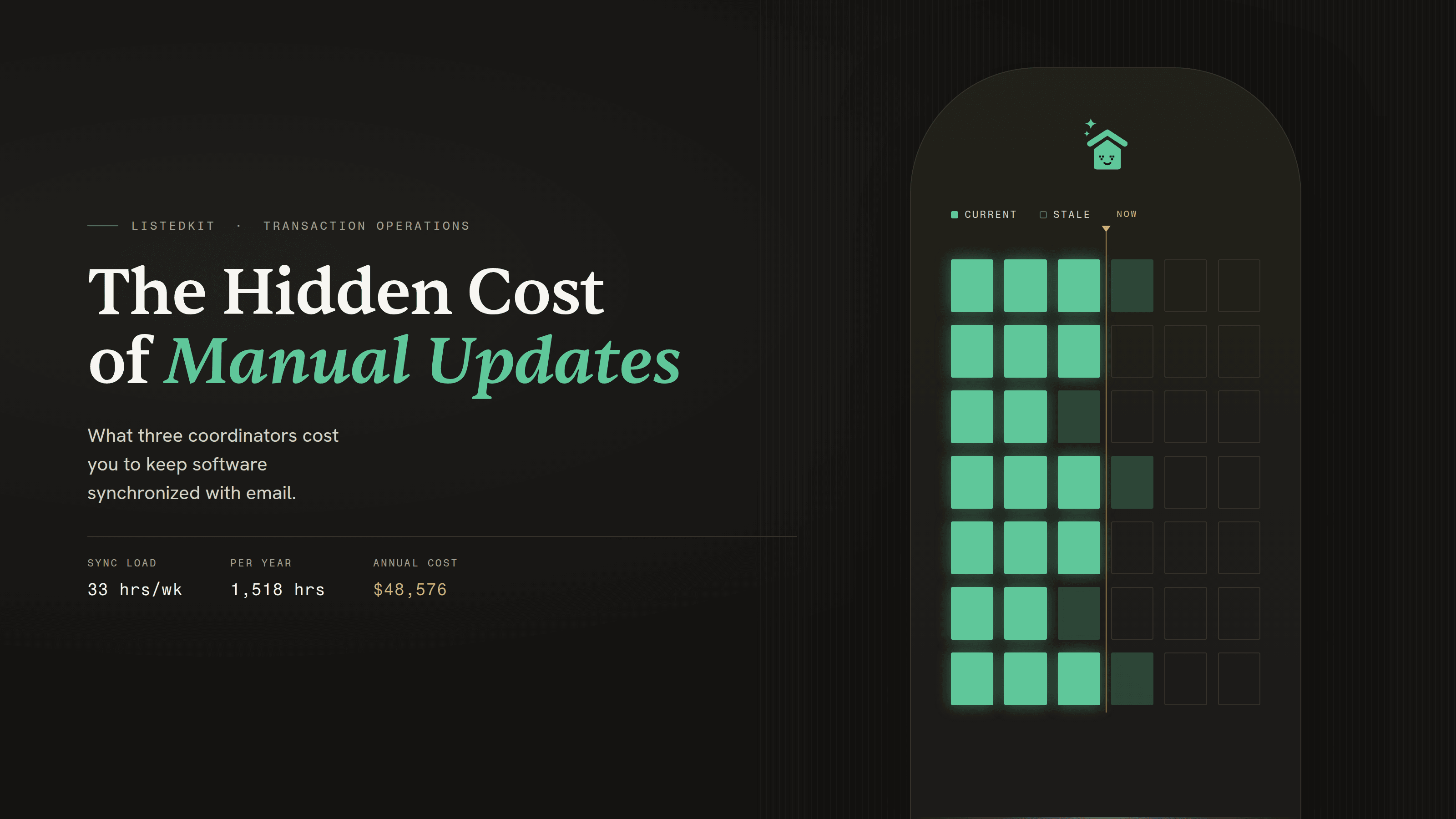
Most operators cannot answer that, because the work never appears on an invoice. It is absorbed into coordinator salaries you are already paying, so it looks free. It is not. For a three-coordinator team it usually runs close to $49,000 a year, roughly two-thirds of a full-time position that exists only to retype what already happened somewhere else.
This article gives you the one-week audit to measure that number on your own team, a scorecard to grade it, and the math to turn hours into dollars before your next hiring decision.
What Are Manual Transaction Updates?
Manual transaction updates are the work of noticing that something changed in a transaction and re-entering that change into your transaction management system by hand. The change arrives first in an email, an addendum, an inspection report, or a lender request. The software only learns about it when a person types it in.
That work has three steps, and only the last one is visible in your software.
Noticing. Someone scans inbound messages and recognizes which ones contain a change that matters. An email reading "we agreed to push closing to the 27th, confirming" counts, even buried nine replies deep in a thread.
Interpreting. The lender did not write "new financing contingency date: October 3." They wrote something that implies it. Your coordinator has to know this state counts business days, that last week's counteroffer superseded the original terms, and that "seven days after acceptance" runs from a date that was itself amended.
Updating. Open the transaction. Change the date. Adjust the three downstream tasks hanging off it. Update the checklist, re-share the timeline, send the notification, log the document.
You hired a coordinator for the judgment in step two. Most of their day goes to steps one and three. That is the cost this article is going to put a number on.
Run the One-Week Sync Audit
You do not need a consultant or a time-tracking rollout. You need five business days and two numbers per person.
Pick your three busiest coordinators. At the end of each day, each of them logs:
- Change events noticed. How many times did an email, document, or call contain a change that had to be reflected in the system?
- Minutes spent reflecting those changes. Not the coordination work, not the client call. Only the noticing, interpreting, and entering.
That is the whole instrument. Two numbers, five days, about ninety seconds a day per person.
Then pull three more figures at the end of the week, because hours alone will not tell you whether the lag is hurting you.
Median file staleness. On Thursday afternoon, pull ten active files at random. For each, find the most recent material change in the email thread and compare its timestamp to the last update in the system. The median gap is your true latency.
Escalation source. Look at your last ten fire drills. How many were discovered by a person happening to notice, versus by the system flagging something?
Rework rate. Of the change events logged this week, how many required a correction afterward because the first entry was wrong, incomplete, or superseded?
The Sync Load Scorecard
Score each metric, then total it. Anything above six needs a plan, not a pep talk.
1. Sync hours per coordinator per week
Multiply average daily change events by average minutes each, then multiply by five.
- 0 to 5 hours. Healthy (0 points). Sync work is a rounding error on the week.
- 5 to 9 hours. Watch (1 point). You are losing roughly a day a week per person.
- 9 hours or more. Critical (2 points). More than a day a week per person goes to transcription. This is the band most in-house teams land in.
2. Median file staleness
- Under 4 hours. Healthy (0 points). The record is close enough to trust on sight.
- 4 to 24 hours. Watch (1 point). Same-day decisions are being made on yesterday's file.
- Over 24 hours. Critical (2 points). Your broker-level view of active files is reporting history, not status.
3. Escalation source
- Mostly system-flagged. Healthy (0 points).
- Roughly even. Watch (1 point).
- Mostly human-noticed. Critical (2 points). Your early warning system is your team's attention, and attention does not scale with file volume.
4. Rework rate
- Under 5%. Healthy (0 points).
- 5% to 15%. Watch (1 point).
- Over 15%. Critical (2 points). You are paying for the same update more than once.
Reading your score. 0 to 2, your sync load is not your constraint; look elsewhere for capacity. 3 to 5, you have a real but survivable drag, and it will get worse with volume. 6 to 8, manual sync is your binding constraint, and hiring into it will cost more than fixing it.
Turn the Hours Into Dollars
Here is where the number stops being abstract.
Take a coordinator logging 22 change events a day at an average of 6 minutes each. That is 132 minutes daily, about 2.2 hours, or roughly 11 hours a week. Across three coordinators, 33 hours a week.
Now price it. Transaction coordinator pay averages around $52,000 a year nationally, per our transaction coordinator salary guide. Divide by 2,080 working hours and you get $25 an hour. Load it for payroll taxes, benefits, software seats, and equipment at a conservative 1.28x and you land near $32 an hour.
Run the arithmetic across a working year of 46 weeks, after holidays and PTO:
- 33 hours per week x 46 weeks = 1,518 hours a year
- 1,518 hours x $32 = $48,576 a year
Call it $49,000. That is what three coordinators cost you to keep software synchronized with email. It is 0.73 of a full-time equivalent, and it buys no coordination, no client service, and no compliance review. It buys data transfer.
Two things to do with that number. First, compare it against what fixing the workflow would cost, rather than against zero. Second, before you approve the next ops hire, split the proposed role into coordination work and system-updating work. If more than a third of it is the latter, you are hiring sync capacity, which is the part most likely to be absorbed by tooling.
What the Numbers Look Like on Real Teams
The audit gives you your own figure. For calibration, here is what teams told us they were carrying before they changed the workflow.
The Home Gurus, a five-person TC team running roughly 200 transactions a year, spent at least an hour per file just reading the contract and counting out calendar dates. At their volume that is around 200 hours a year on date extraction alone, before anyone coordinated anything. Their chief of staff described getting that back as recovering a whole workflow.
Nancy Chu Homes, a four-person operation in North Jersey, works in an attorney state where riders move timelines mid-deal. Every rider is a re-read and a recalculation. Raf, their director of operations, estimates he got about two hours back every day once he stopped being the person who had to read every contract, and redirected that time into marketing and systems.
The Krista Hartmann Home Team, an eight-agent RE/MAX Results team in St. Louis, started with five separate systems and a coordinator carrying as many as 18 deals at once. They report saving 3 to 5 hours per transaction after consolidating onto one file everyone worked from.
Rush Home is the cautionary one, and it is a staleness story rather than an hours story. A deal went a week past its settlement date, fell apart, and went back on the market without the team lead knowing. The tracker never surfaced it; he found out because he happened to check. Marcus now estimates he saves five to ten hours a week, but the first thing he mentions is not the hours. It is knowing what is actually happening across every file.
That last one is the argument for measuring staleness alongside hours. A team can be efficient at updating and still be blind, because efficiency at transcription does not tell you what nobody transcribed.
Why This Is Not a Discipline Problem
The reflex is to write an SOP, add a mandatory daily update block, and build a checklist to make sure the checklist gets updated. It does not hold, and the reason is structural.
Transaction changes are event-driven and continuous. Manual updates are batch-driven and happen whenever someone has capacity. You cannot close that gap with discipline; you can only close it by shrinking the batch, which means updating more often, which means spending more coordinator hours on transcription. The better your team follows the process, the more the process costs.
Nor can you template your way out. Our data study The Myth of the Standard Closing found that across more than 3,500 closings worth over $1.4 billion, 93% had a deadline structure no other deal in the study shared, and a static template matched only about 7% of transactions. If nearly every file is structurally unique, the interpreting step lands on a person every time.
Two outside numbers put the drag in context. A Harvard Business Review study of 137 users found workers lose just under four hours a week simply reorienting after switching applications, which is the tax on a coordinator bouncing between inbox, PDF, timeline, and checklist all day. And in a file audit of a 22,000-agent brokerage, 40% of active files had incomplete disclosures and 39% of closed files were missing at least one post-close document. Those were not unmanaged files. They were files managed by hand.
Staffing ratios follow the same logic. Inman reported in April 2026 that Real's reZEN platform lets the company run one full-time brokerage employee per 94 agents against a nearest public competitor at one per 45. Most independent brokerages will never build their own platform, and they do not need to. The point is that the ratio is largely a function of how much manual sync work your stack forces onto people.
Where the System of Record Fits
You still need one. Compliance, broker file review, audits, and post-close integrity all require a defensible record. The question is only whether a person has to be the transport mechanism between what happened and what the record says.
We made that category argument in full in why transaction management software still feels manual, so this piece stays on the measurement question. The short version: a system of record stores what someone entered, and an intelligence layer keeps that record close to what is actually happening. Brokerages asking for transaction software that stays current are really asking for both.
That is the job Ava does. She reads contracts, addenda, and documents as they arrive, extracts the dates and terms, follows the logic across counteroffers to find the terms that survived, recalculates the timeline including the business-day math, and flags what is missing. A coordinator still reviews and approves. Nobody has to hand-transcribe the change, which is the line item you just measured.
Worth saying plainly: this does not replace your coordinator, and it does not remove human review. It removes the transcription.
What to Do With Your Number
Run the audit next week. It costs you five days of two-number logging and gives you four figures: sync hours, median staleness, escalation source, and rework rate.
Then act on the score. If you came in at 6 or higher, the sync load is your constraint, and the next ops hire will mostly absorb it rather than fix it. Take the same measurement again 60 days after any change, tooling or process, and compare. Those four numbers are also how you judge whether any tool, ours included, actually moved anything.
If you want the task-level view of where the load concentrates, the TC workflow for inbox monitoring, contract intake, and document chasing is the map, and the transaction coordinator checklist shows how many line items are really "check whether something changed." For the broader picture of what a transaction costs to run, we broke down where the time actually goes across a full file.
The Bottom Line
The bottom line? Manual transaction updates are a real line item, usually around $49,000 a year for a three-coordinator team, and the only reason it is invisible is that it hides inside salaries you already approved.
Measure it this week. Then decide whether you want to keep buying it.
See Ava keep a transaction current. Start with your first intake and watch what happens when the software reads the deal instead of waiting to be told about it.