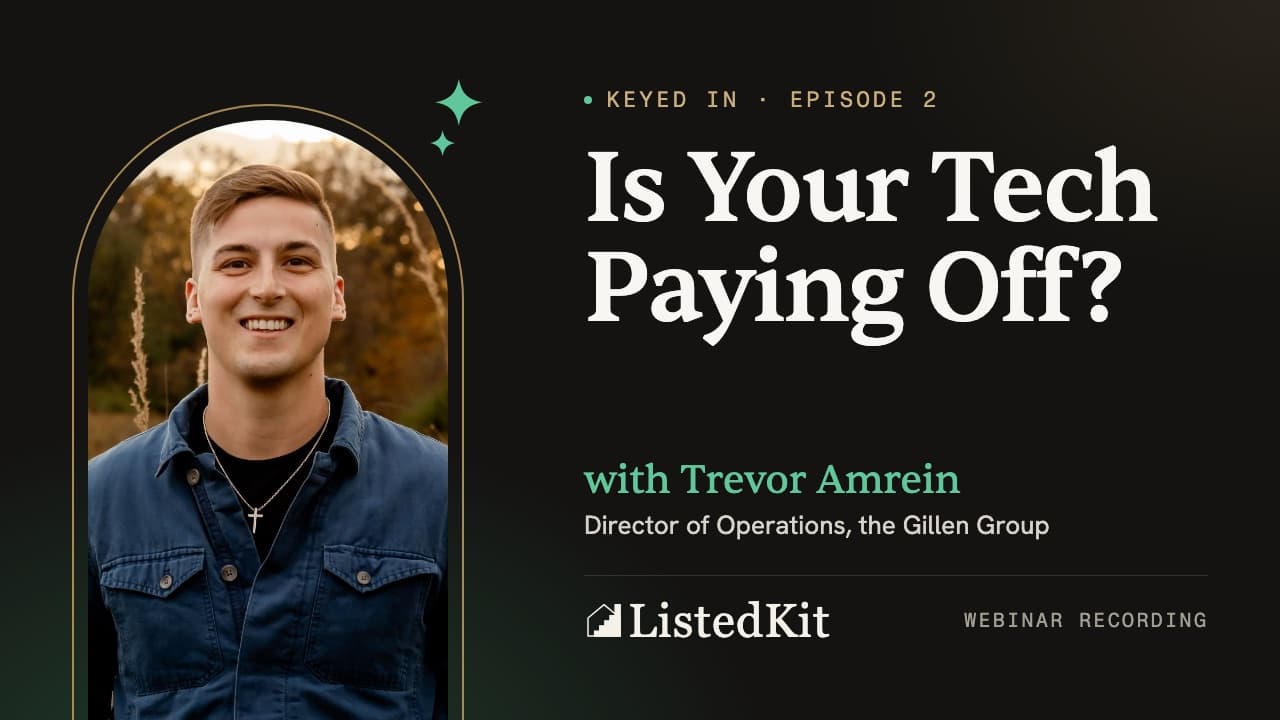
Most real estate teams already use AI. Someone drafts emails in ChatGPT, someone else writes listing descriptions, and the team's tools still don't talk to each other. Client details live in notebooks and spreadsheets, the TC carries the whole process in their head, and the only time anyone looks closely at the numbers is when the brokerage asks for splits.
Trevor Amrein has worked on both sides of that problem. Before becoming Director of Operations for the Gillen Group, a $125M+ Keller Williams team with 25 agents across Dayton, Columbus, and Cincinnati, Trevor ran productivity coaching for 42 agents. Now Trevor builds the systems behind the team, from financial reporting to transaction operations to capacity planning. In the second episode of Keyed In, Trevor walked through how the team connected its tools and how it decides which ones are worth keeping.
The short version: a team handles more deals by connecting its systems so information moves between them without anyone retyping it, and by judging every tool on the return it produces and the leading numbers it moves, not on how it feels to use.
How can a real estate team connect its tools with AI instead of using one-off prompts?
When Trevor stepped into the role, the team had no end-to-end setup for AI. People used it for single tasks, like drafting an email. Trevor's view is that the value sits somewhere else.
"Really, the power in them is that they can connect and communicate to multiple platforms."
Trevor Amrein, the Gillen Group
In practice, that means tools that build context over time. Trevor uses an inbox assistant that learns from email, drafts replies, and tags what needs a response, and connects that work to Claude and then to the CRM. The goal is to "get out of just doing one off prompts" and think about how each tool hands information to the next. If you're mapping this for your own brokerage, our guide to a transaction intelligence layer covers the same idea from the deal side.
How do you get a TC's process out of one person's head?
The team Trevor joined ran mostly on memory. Agents kept clients in a notebook, a spreadsheet, a CRM, or nowhere at all, so there was no shared database to build on. The team's TC, who has two decades in the business, handled transactions the same way.
"Sometimes 20, 30, 40 transactions in a month, and a lot of that was all just living inside of her noggin, and she has a binder that was a physical place in which she would manually track everything."
Trevor Amrein, the Gillen Group
The knowledge wasn't the problem. The problem was that a huge share of the work was intake and data entry across the platforms the team has to use for compliance, and none of it was written down. So Trevor and the TC sat down and mapped the process step by step, starting with day one through three. Trevor's calendar invite for those sessions was titled "extracting" the TC's brain.
Karan Khanna, ListedKit's co-founder, put the stakes plainly: if all of it lives in one person's head and that person takes three weeks off, the agents are in trouble. Writing the process down is what lets an experienced TC spend their time with clients and agents instead of on the same data entry every file.
How do you capture phone calls so details reach the TC?
A lot of what matters in a transaction is said on the phone, and most of it never makes it into the file. The Gillen Group records calls with Pocket, a small recording device (Trevor was clear it isn't a sponsor). After an inspection call, a summary goes to the TC's inbox, and because ListedKit reads that email, Ava drafts the defect notice for the TC to review.
"Ava can then draft a defect notice, you know, to go out to the client and, hey, we've handled 80% of the labor part of the process."
Trevor Amrein, the Gillen Group
The TC then approves it or makes small changes. Pocket also turns promises made on a listing appointment into Google Calendar tasks, which Trevor uses every day.
You don't need hardware to start. Karan pointed to apps like Granola, and to the record button on an iPhone call, which saves the conversation to Apple Notes. Whatever you use, the point is to stop relying on an agent to repeat every detail to the TC.
"It's the biggest source of mistakes. And what do mistakes cause? Deals to get delayed, they don't close properly, they don't close on time."
Karan Khanna, ListedKit
Which leading indicators should a real estate team track before the P&L?
Karan asked about the P&L as the team's North Star. Trevor agreed only partly.
"The P&L is the ultimate lagging indicator. So you need to be tracking things on the front end of that."
Trevor Amrein, the Gillen Group
Here's how the team connects it. Follow Up Boss, the team's CRM, sends activity data through an API connection into Google Sheets, using a Google Sheets extension called Coefficient that is free to start. QuickBooks sends the P&L into the same workbook on a schedule. Instead of logging into QuickBooks once a month, the team opens one sheet every day that holds both.
Trevor estimates there are 10 to 14 numbers worth tracking in real estate. The ones Trevor named:
- Attempted contacts
- Speed to lead, which matters most for the team's online leads
- Appointments set and appointments held
- Clients signed
- How long it takes to get a signed client to the closing table
The team also changed what it celebrates. Instead of only rewarding last month's biggest commission, which reflects work from 90 days ago, "we actually reward the front end of the things" in team meetings. Trevor calls Q4 "lapping season": the agents who keep setting appointments through the holidays are the ones whose numbers show up in January.
How do you decide if a real estate tool is worth paying for?
Trevor encourages agents to try tools, and has tested plenty personally: "I've probably spent more than 6 figures on just testing out different platforms." One that stuck is Land Voice, which a couple of agents use to load each morning's new expired and for-sale-by-owner listings straight into Follow Up Boss, assigned to them. When they sit down to prospect, the list is ready, so the time goes to calls instead of building a list.
Testing is welcome, but every test has a frame. The team uses GPS (goals, priorities, strategies) for each 90-day period, and a new tool can be one of the strategies. At the end of 90 days, the team checks whether it worked. For bigger investments, Trevor sets a return target.
"I like to try to get a 7x return on things."
Trevor Amrein, the Gillen Group
The target varies by category, and lead generation may come in lower. Trevor keeps the big tool investments in the team's Google Sheet, with what each cost and what it would need to generate, and tags every lead and closed deal by source so the return can be traced. If a tool falls short, that's the signal to look deeper.
What about agents who already track everything for their brokerage splits? Trevor's answer was no, that isn't enough. If the only time you look at the numbers is when you report splits, "that's way too late in the process." You have no view of what the next 90 days, six months, or year will look like. If you're still comparing tools, our roundup of AI tools for real estate is a starting point to test against.
Where is the operations role heading, and where should you start?
Karan counted four jobs in Trevor's role: watching the health of every transaction, running the tech stack, coaching agents, and still producing deals. Asked what should be automated, Trevor was direct about data entry across browser tabs, which Trevor called "gross."
"I would love for my job to just be more and more strategic."
Trevor Amrein, the Gillen Group
The end state Trevor described is oversight and coaching: sitting down for a one-on-one with an agent and already knowing, from accurate data, how that agent's business is doing.
To get there, start by asking. Trevor treats AI as a thinking partner, with discernment about the answers. That's how Coefficient was found in the first place: Trevor described the goal, and the AI suggested it. The habit worth copying is how every prompt ends.
"I always end it with, ask me any clarifying questions that you have."
Trevor Amrein, the Gillen Group
Give it the whole picture. Trevor's template goes roughly like this: I'm a director of operations for a team of this many people. Here's a pain point we have, here's how our systems work today and what we don't like, and here's what we'd like to do eventually. How would we bridge that gap? Ask me any clarifying questions. You can also start with one specific pain point instead of the whole system; Trevor's answer to which was "both."
From the Q&A
Did your agents start using a tool like Pocket on their own, or did you make it part of the process? Trevor used it first, then brought it to the team. "They have to see you doing it first." People adopt at different speeds, so some will jump in right away, some will come around once they see the benefit, and some will take longer. Coach them through it together, watch how the next few attempts go, then let them run.
What dialer does the team use in Follow Up Boss? The built-in Follow Up Boss dialer, because it tracks every attempted call and transcribes recorded calls. Trevor uses those transcripts with an AI sales coach to prepare for coaching sessions with agents.
How do you keep a long AI conversation from losing track over time? Trevor has Claude keep a running log of decisions as the conversation goes, so the context isn't lost. Karan added three habits: keep a short document of context the AI reads first, compact the conversation early, and use a separate chat for each topic.
Key takeaways
- Connect before you add. Before buying another tool, check how it will pass information to your CRM, your transaction system, and your reporting.
- Write down your TC's process. Map it step by step with them, starting with the first three days of a new file.
- Capture calls. Start with your phone's record button or a free app, and make sure the summary reaches the person running the file.
- Track five leading numbers. Put attempted contacts, speed to lead, appointments set, appointments held, and clients signed in one sheet next to your P&L.
- Give every new tool a 90-day test and a target. Tag leads and closings by source so you can see what it actually returned.
Get the two worksheets
The worksheets under the video turn this conversation into something you can use this week. The first is a one-page check of whether your team can handle more deals without piling more work on your TC: six yes or no questions, with a next step for each result. The second is a four-page, 90-day tool evaluation built on Trevor's approach, from connecting the test to your goals to counting the full cost, setting a return target, keeping a weekly scorecard, and deciding whether to keep, adjust, stop, or extend.
For the client communication side of the same question, see Episode 1 of Keyed In, on how to use AI on your real estate team without losing the human touch. And if you lead a team, here's how ListedKit works for real estate teams.