Industry Insights
Karan Khanna on AI adoption in the real estate industry, compliance risk and the rise of the independent brokerage
There is a conversation happening in real estate right now about whether AI is going to take over the back office for real estate teams. I think the industry is thinking about it wrong.
Here is what I mean. The people with the authority to set an AI strategy are often the most enthusiastic but in my experience, they are also the furthest removed from how that work actually gets done in the background. team leads and brokerages that are AI first but not fully sure what the playbook needs to be, so they dump it on their team to figure out individually. Then on the individual level, the team members are scared to overuse AI, make mistakes, and upset the team lead. That dynamic has not resolved itself.
I have an unusual vantage point on this. I am not the one running a brokerage or coordinating deals. I build the software that sits underneath teams in all 50 states, which means I watch how transactions actually move, where they stall, and what happens when a team drops a new tool into the middle of an established process. What follows is less triumphant, and I hope more useful, than most of what the industry is saying out loud right now.
The adoption number is high. The adoption is not deep.
Realtor Property Resource, a subsidiary of the National Association of Realtors, reports that 82% of agents have integrated AI tools into their business, up sharply from the 68% recorded in NAR's 2025 technology survey. By headline adoption, real estate looks like an early adopting industry.
But the same research contains a second number that is harder to celebrate. Only 17% of those agents report AI having a significant positive impact on their business. Roughly a third report a moderate one. So the gap I am describing is real and measurable. A large majority of the industry is using these tools, and a small minority is getting much out of them.
The explanation is not about the tools. It is about where the information lives. Here is what I mean by that.
Take the example most people will recognize. You tell ChatGPT something about how your deals work, and it tells you it will remember. It will say about 20 things. But if you go into the memory where you can actually see what it is holding on to, it is probably remembering one of those 20. And even when it is storing memories, at a certain point that memory gets so bloated it cannot surface one specific detail among the hundreds it has accumulated. That is just not how context works.
Then there is the problem of the ground moving. Model providers ship new versions constantly and behavior changes with them. OpenAI released four new models in the last couple of months, and in that time each one has behaved very differently. Three months ago ChatGPT could have recommended something different from what it recommends today, or tomorrow, and nobody has any control over who is being told what.
Which brings me to the question I think every brokerage should be asking, and almost none are. Where is this information coming from? Is my AI just searching the internet and guessing, or is it based on some amount of truth? If you cannot answer that, you are running the risk of being handed the wrong information.
I will be honest that maintaining an answer to that question is not trivial, including for those of us whose job it is. You can tell Claude your whole process and build it out, and then tomorrow they release a new model and suddenly it is not doing what it did yesterday. You start to realize that maintaining and controlling your own system becomes a full time job. Trust me, we know. We are building that system for everybody, every single day.
The line between what a machine should do and what a person must
I draw the line in the same place every time. At the point where a mistake becomes someone's liability.
On the machine side I do contract reading, email triage, form filling, preparing signing requests, and answering an agent's basic questions while they are out of the office.
On the human side, reviewing what the AI pulled out of the contract and finalizing that information before it goes into the deal. Compliance checks, done seriously and thoroughly, even when the AI has taken a first pass. Confirming that the right people are getting the right emails and the right signature requests. And every client conversation, every piece of crisis management, every relationship with a lender or a vendor or another agent.
The logic underneath that list is compounding error. In a transaction, an early mistake does not stay small. It is really important to have a coordinator there to catch and review what the AI is doing, so that one hallucinated number on day one does not bleed through the entire deal and leave everything wrong by day 30.
That is a specific property of real estate that generic AI advice tends to miss. Dates depend on other dates. A wrong figure entered at intake propagates into the timeline, into the calendar invitations, into the emails sent to twelve people, and into the compliance file. By the time anyone notices, the correction is no longer a correction. It is an explanation.
"I can fire my TC"
The most common misunderstanding I run into is also the one I push back on hardest, and I hear it in demos. People see the product and tell me AI is going to replace the TC, or that they can fire their TC. While I understand the spirit of it, I do not agree with it.
My argument is not sentimental, it is structural. A tool like ours lets one coordinator oversee Ava working across 50 deals instead of doing 10 themselves. It makes them far more productive, and it makes them more important to the business rather than less, because they are now accountable for the output of AI across a lot more transactions. They are almost turning into a manager of assistants.
Someone has to hold the pen. There will always need to be a person at the back office helm who oversees what the AI is putting out, who is liable for that work, who takes ownership of it, and who is opinionated about the quality of the work being done and what the future of that work looks like.
The planning work does not disappear either. Most operations teams already sit down quarterly or annually and ask whether their processes are still right. That meeting does not go away when a machine is doing the tasks. The AI still needs a clear set of instructions that can be renewed, optimized and revisited as tools change. Someone still needs to own that.
I am not going to dodge the uncomfortable half of this. Headcount structures will change. The days of needing 10 coordinators to handle 100 deals may well be reduced to three or four overseeing that much volume. But those coordinators are going to be required at other businesses that are using AI to do more deals themselves.
What I expect is less a contraction than a flattening. I have seen organizations with virtual assistants, coordinators, a manager of the assistants, a manager of the coordinators, and a director of operations sitting above all of it. That is way too much bloat for the work we are looking at. I imagine it squishing down to where everyone is a manager of sorts, spending part of their time in the product doing the work and the rest watching what Ava has produced and moving the needle forward.
The common misunderstanding I often hear people telling me is they do not want AI talking to their clients. They are right. But they have also drawn the wrong conclusion from being right.
That objection comes from a place of self defense. My whole job is to talk to my clients, I do not want AI taking my job. I hear that, and I do not think AI should be deployed there. But that is a drop in the bucket of where AI could actually help you with all the other work you are doing. The point of automating the back office is to buy more of exactly the time you are trying to protect.
The thing nobody is worried enough about
If you ask me what people are too relaxed about, the answer is compliance. My evidence is our own customers.
I know that telling customers to move slower is not the usual sales motion. I am more worried about the wider industry, where the exposure is larger and far less supervised. Brokerages have agents under them throwing their contracts into ChatGPT. It may or may not recommend the right thing based on that contract. Nobody can guarantee anything, because it is not being trained or controlled by your compliance standards, whether those come from your brokerage or your association.
I think we are running an unhedged risk here, and I am fairly specific about the shape of the failure I expect. If we do not change the way we are thinking, there is going to be a spell of mistakes made because ChatGPT told me so. That may then flip the industry back on its head about being open about using AI at all.
That is the part worth sitting with. The likeliest threat to AI adoption in real estate is not regulation and it is not resistance. It is a cluster of visible, embarrassing, traceable errors that makes the whole category radioactive for a couple of years. I think it is preventable, but only with a top down approach rather than a hope that individual agents will work it out on their own.
There is a related irony I run into constantly. In the same demo I will hear an objection to paying for a tool when ChatGPT is free, and then, later in that same conversation, a question about whether our product is secure. On the specifics, the second question has a counterintuitive answer.
When you use OpenAI, Anthropic and Gemini as an API provider, they do not take the data we are sending and train a model on it. When you go and sign up personally on one of those platforms and put your contract in, the default setting actually allows them to train on your data.
That distinction holds up. OpenAI states that data submitted through its API is not used to train its models by default, while consumer ChatGPT accounts are opt out rather than opt in, with the training toggle sitting in settings where most people never look. An agent pasting a purchase agreement into a personal ChatGPT account is making a different privacy decision than they think they are.
What the franchise was actually selling
The last thing I want to talk about is brokerages, because what looks like a business story is really an operational one.
The historic value of affiliation was not marketing. It was infrastructure. Dues bought compliance support, back office capacity and a staffed operational spine that an independent shop could not assemble alone. I pay all these dues, I receive the support, I have this big staff to run the business, and I make a decent cut throughout. My agents pull in volume, I pay all these fees, I am fine, I am compliant.
Software changed the arithmetic of that trade. Brokerages and teams are realizing they could use these software and AI solutions to eliminate and mitigate a lot of the cost and risk they used to carry in owning a brokerage, while still bringing in the same amount of money. So why keep paying all of those dues?
The traditional moat you had as a brokerage was your connections. I am part of this association, this affiliation, we can get you these benefits as an agent, come join us. That wall is being broken down every single day.
The market data suggests this is real. Inman reported that external agent moves rose 25% quarter over quarter in the first quarter of 2026, representing $16 billion in annualized production, and that in nine of twelve brand categories, more than 30% of departing agents went independent.
I do not want to oversell how far along this is. I would not say 20% or 30% of brokerages became independent in the last year. What I can say is that in the last few months we have seen multiple teams break off and become independent brokerages. We are really early on the trend.
The part I find most interesting is about speed rather than cost. If a franchise's advantage was a shared operational spine, its disadvantage is how long that spine takes to move. You will see the head of a franchise announce to the whole team that starting tomorrow we need to do a certain thing. That will not take effect for weeks or months, because it depends on the people within the franchise team, and then the layers below them, and eventually the agent going in to update their own systems.
A small team running one documented process can change it once and have every open file follow the new rule immediately. A large organization announcing the same change is relying on each layer to hear it, understand it and apply it by hand.
I want to be clear that this is a choice rather than a law of physics, which is the part large brokerages should probably find uncomfortable. The bigger teams could do this if they had invested in a system that was consistent across the board. They have often chosen instead to offload the responsibility of keeping the system up to date to the next rung down the line, which leaves the agent or the coordinator to work out what the right way to do things actually is. That needs to change.
It connects to why fragmented tooling is so expensive. When an agent updates one system, the broker checking on the business and the coordinator managing the file usually do not see it. Most of the time they do not. Most of the time the coordinator is just told to go figure it out.
"Check your work"
If there is a piece of common industry advice that is being abandoned exactly when it matters most, it is this one. Check your work. That should never go away. It has dwindled as people decide AI is going to do everything for them.
Closing thoughts
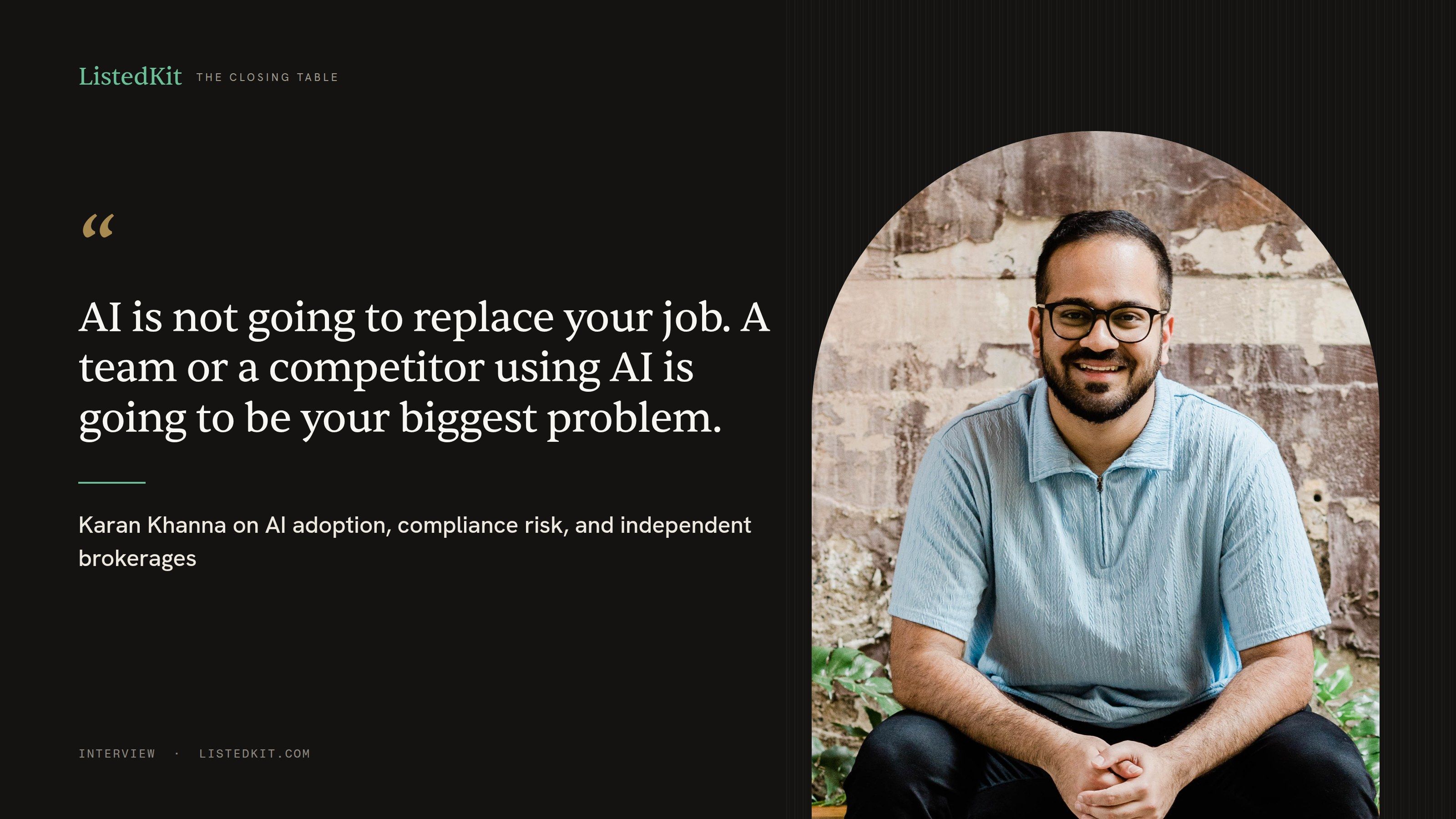
At the end of the day, AI is not going to replace your job. A team or a competitor using AI is going to be your biggest problem in the days to come. They will have something handling so much of their back office work that their agents are free to spend their time in front of clients, while yours are heads down filing paperwork and still doing a lot of that work by hand.
Getting there is a leadership problem before it is a technology one. You cannot be enthusiastic without being specific. Handing your team an AI first mandate and expecting individual agents to work it out on their own is the model flipped upside down, because it puts the decision with the people who have the least context and the most to lose by getting it wrong.
So step up with a playbook. Standardize the tools, so a compliance problem cannot walk in through twenty different chat windows. And enforce the rule that has not changed and is not going to: check your work.
Be equally clear about what a machine is not going to do for you. It will not take on legal liability. It will not handle the call when a deal is falling apart on a Friday afternoon. It will not hold a client relationship together.
But when you build a real system, one that takes the back office clutter off the desk instead of spreading it across more tools, you give your agents all hours of the day to spend with clients and win more business. That is how you outshine everyone else.
Karan Khanna is the founder of ListedKit, which builds Ava, an AI assistant for real estate transaction management.