Best Practices
Email Newsletters for Realtors: The Complete Guide to Emails That Actually Get Opened
What separates the agents whose emails get opened from the ones whose messages go straight to trash?
It's not the subject line hack or the fancy template. It's relevance. The agents with the highest open rates send emails their clients actually want to read, and the most opened emails in real estate aren't market update newsletters or "just listed" blasts. They're transaction updates. Status emails about the client's actual deal. Messages that answer the question every buyer and seller is thinking: "What's happening with my house?"
This guide covers everything you need to know about real estate email newsletters, from building your list and choosing a platform to the strategy that outperforms every generic market update. Plus, we'll show you how transaction communication (the emails your TC sends during the deal) might be the most powerful email marketing you're not tracking.
Why Email Marketing Still Outperforms Everything Else
Let's start with the numbers, because they make the case better than any opinion.
Email marketing generates $36 to $42 for every dollar spent, making it the highest-ROI channel in real estate marketing. That's not a typo. For every dollar you put into email, you get back 36 to 42. Social media converts 40% less effectively than email, and paid ads cost $5 to $60 per lead with conversion rates of 1-3%.
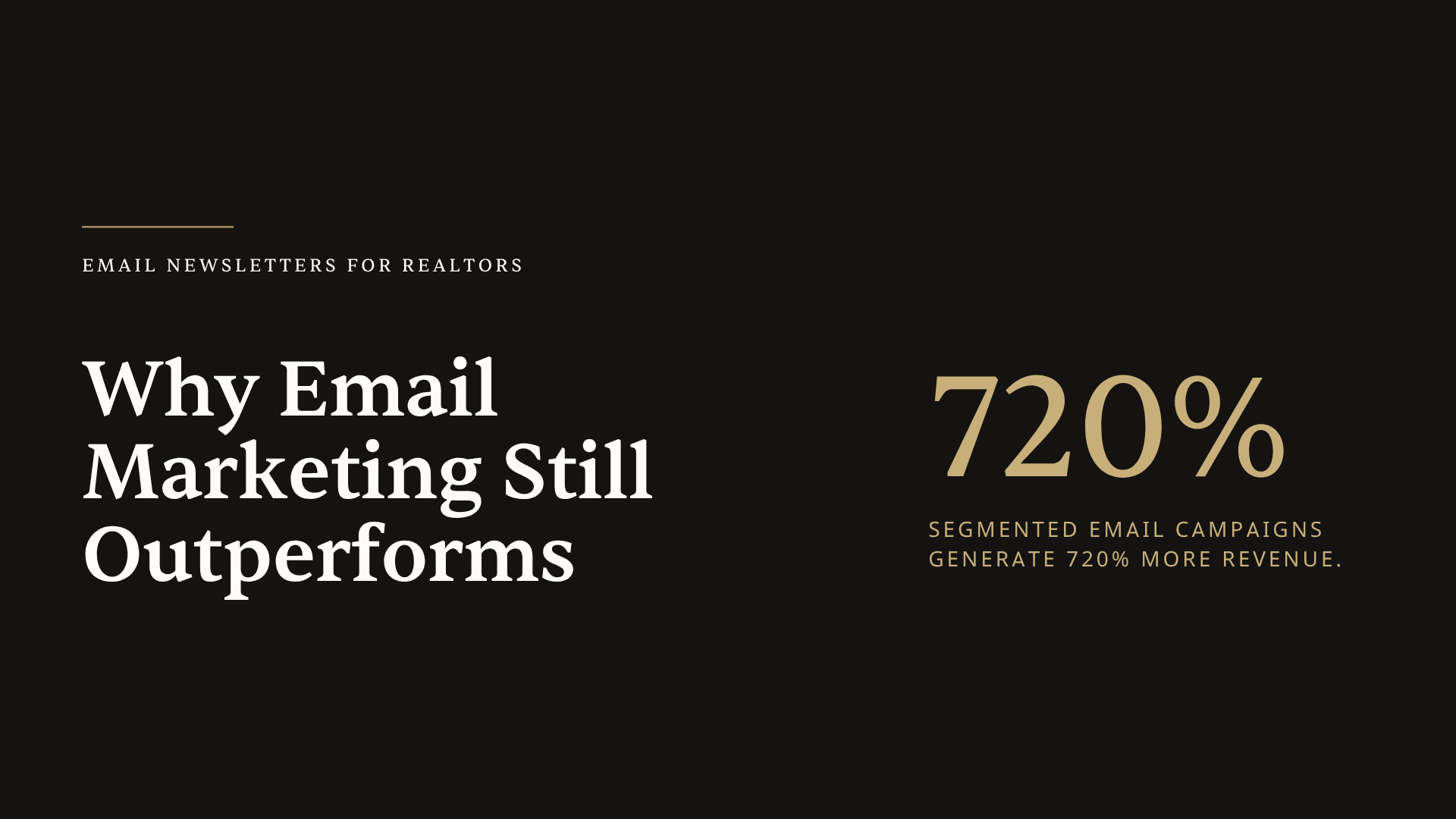
The real estate email open rate averages 23%, which is above the all-industry average of 21.5%. But here's where it gets interesting: segmented email campaigns generate 760% more revenue than non-segmented blasts. That means the difference between a generic monthly newsletter and a targeted, personalized email strategy is nearly 8x the revenue.
And email is getting more effective, not less. Open rates have increased 32% since 2018, and click-through rates have jumped 54% in the same period. Despite what social media gurus might tell you, email is the most reliable way to stay in front of your clients.
What Types of Emails Should Realtors Send?
Not all emails serve the same purpose. The most effective real estate agents use a mix of these email types:
Market Update Newsletters
These are the classic "monthly newsletter" most agents think of first. They include local market stats, interest rate updates, new listing highlights, and maybe a home improvement tip. They work for staying top of mind with your sphere, but open rates are typically average (20-25%) because the content isn't personalized.
The key to making market updates work: segment by neighborhood or buyer/seller status. A first-time buyer in Florida doesn't care about luxury market trends in California. Send relevant data to relevant people.
Just Listed / Just Sold Announcements
These serve double duty. For potential buyers, they showcase your active inventory. For your sphere of influence, they demonstrate that you're active and successful. Keep them visual (high-quality photos), brief (3-4 sentences max), and include a clear CTA.
Drip Campaign Sequences
Automated email sequences that nurture leads over time. A typical buyer drip might include:
- Day 1: Welcome email with a local homebuyer guide
- Day 3: "What to expect in the buying process" overview
- Day 7: Neighborhood spotlight relevant to their search criteria
- Day 14: Market conditions update
- Day 30: Check-in with recent listings matching their criteria
The beauty of drip campaigns is they run automatically. Set them up once and they work for you 24/7.
Event and Educational Emails
First-time homebuyer seminars, open house invitations, market outlook webinars. These position you as the local expert and give recipients a reason to engage beyond just reading.
Post-Closing Nurture Sequences
This is the most neglected email category, and potentially the most valuable. The 30-60-90 day window after closing is when clients are most likely to refer you, but most agents go silent after the closing table.
A post-closing sequence might include:
- Week 1: Congratulations and "here's what to expect as a new homeowner" guide
- Month 1: Homeowner maintenance checklist for the season
- Month 3: "How's the new home?" check-in with a referral ask
- Month 6: Neighborhood market update showing their equity growth
- Year 1: Home anniversary message with a small gift card or market analysis
The Emails Clients Actually Open: Transaction Updates
Now here's what nobody in the email marketing world talks about.
The highest-performing emails in real estate aren't your newsletters. They're the transaction status updates your clients receive during their deal. Think about it: when a buyer is under contract, they check their email constantly looking for updates on their inspection, appraisal, financing, and closing date. These emails get opened immediately because the recipient has a personal stake in the content.
Every transaction generates 15-25 emails: inspection scheduled, appraisal ordered, title clear, clear to close, closing confirmed. Each one of those is a touchpoint where the client experiences your professionalism (or lack of it). And each one builds the trust that turns a one-time client into a lifelong referral source.
This is where transaction coordinators become your secret weapon for email marketing. A great TC sends polished, timely, informative transaction updates that keep all parties in the loop. The agent's name is on every email, building the agent's brand during the most emotionally intense period of a client's life.
The agents who treat transaction communication as "just admin work" are missing the biggest email marketing opportunity they have. Every well-crafted status update is a brand impression that no newsletter can match.
How to Build Your Email List (Without Buying One)
Your email list is the foundation. Here's how to build it the right way.
Start With Who You Already Know
Your CRM (or even a spreadsheet) should include every past client, every lead you've ever spoken to, every friend and family member, and every professional contact. For most agents, this initial list is 200-500 people. That's more than enough to start.
Capture Leads at Every Touchpoint
Open houses should have digital sign-in forms (not just a clipboard). Your website should have a lead magnet (free guide, market report, home valuation tool). Your social media profiles should link to an email signup page. Every interaction is an opportunity to grow your list.
Use Lead Magnets That Provide Real Value
The highest-converting lead magnets in real estate are:
- Neighborhood market reports (updated monthly)
- First-time homebuyer guides
- Home seller checklists
- Transaction coordinator checklists and closing timelines
- Home maintenance seasonal guides
Create something genuinely useful. If someone would bookmark it or print it out, it's a good lead magnet.
Never Buy Email Lists
Purchased lists have terrible engagement rates, damage your sender reputation, and violate CAN-SPAM laws if recipients didn't opt in. It's not worth the risk. Grow organically.
Choosing the Right Email Platform
The platform matters less than the strategy, but here are the main options for real estate agents:
| Platform | Free Tier | Best For |
|---|---|---|
| Mailchimp | 500 contacts | Beginners, simple newsletters |
| MailerLite | 1,000 contacts | Lead magnets, automation |
| Constant Contact | None (trial) | Established agents, event marketing |
| Follow Up Boss | None (CRM) | Teams already using FUB for leads |
| ActiveCampaign | None (trial) | Advanced automation sequences |
For most solo agents starting out, MailerLite or Mailchimp's free tier is more than enough. You can always upgrade as your list grows.
But here's something worth considering: the emails that matter most (your transaction updates) shouldn't come from a bulk email platform at all. They should come from your actual inbox.
Why Personal Email Beats Bulk Platforms for Transaction Communication
Bulk email platforms are great for newsletters and drip campaigns. But for transaction-related emails, sending from your personal Gmail or Outlook has significant advantages:
Higher deliverability. Emails from personal accounts rarely hit spam filters. Bulk platform emails, even legitimate ones, get filtered more often because they share IP addresses with thousands of other senders.
Personal feel. When a client receives a transaction update from "jane@janedoerealty.com" it feels personal. When it comes from "noreply@emailplatform.com" it feels automated.
Gmail and Yahoo authentication. Since 2024, Gmail and Yahoo require SPF, DKIM, and DMARC authentication for bulk senders. Personal email accounts are inherently compliant because you're sending one-to-one, not one-to-many.
This is exactly why ListedKit's email automation sends directly from your Gmail or Outlook. Ava drafts contextual emails using actual transaction data (dates, parties, property details, upcoming deadlines) and sends them from your inbox. To the client, it looks and feels like a personal email from their agent, because it is. There's no "sent via" branding, no bulk platform footprint.
Email Content Ideas That Get Results
Running out of things to write about is one of the biggest reasons agents abandon email marketing. Here are 20 newsletter content ideas organized by category:
Market Intelligence
- Monthly local market stats with your analysis
- Interest rate updates and what they mean for buyers
- Neighborhood price trend comparisons
- New development and construction updates
- Seasonal market predictions
Educational Content
- First-time homebuyer tips
- Seller preparation checklist
- Home inspection: what to expect
- Understanding closing costs breakdown
- How to improve your home's value before selling
Community and Lifestyle
- Local restaurant and business spotlights
- Upcoming community events calendar
- School district highlights and updates
- Parks, trails, and outdoor activity guides
- "Hidden gem" local businesses
Personal and Engagement
- Client success stories (with permission)
- Behind-the-scenes of a recent transaction
- Your personal "market picks" (properties you love)
- "Ask an agent" Q&A from client questions
- Annual year-in-review with your stats
The best newsletters mix these categories. A typical monthly email might include one market stat, one educational tip, one community spotlight, and one personal touch.
Email Deliverability: The Technical Side That Matters
You can write the perfect email and it won't matter if it never reaches the inbox. Here's what you need to know about deliverability in 2026.
Authentication Is Non-Negotiable
Since February 2024, Gmail and Yahoo require email authentication for bulk senders. If you send more than 5,000 emails per day (most agents don't), you need SPF, DKIM, and DMARC properly configured. Even if you're under that threshold, proper authentication improves your deliverability.
Most email platforms handle this for you, but verify with your provider. If you're using a custom domain (jane@janedoerealty.com), make sure your DNS records include SPF and DKIM entries.
Keep Your List Clean
Remove bounced emails immediately. Remove unsubscribes (legally required). Periodically remove contacts who haven't opened an email in 12+ months. A smaller, engaged list performs better than a large, unengaged one.
Monitor Your Sender Score
Your sender reputation determines whether your emails reach the inbox or the spam folder. Avoid spam trigger words in subject lines (FREE!!! GUARANTEED!!!), don't use all caps, and maintain a consistent sending schedule. Sudden spikes in volume flag spam filters.
When and How Often to Send
The data on send timing for real estate emails is surprisingly consistent:
Best days: Tuesday through Thursday outperform Monday and Friday. Weekend sends actually show the highest open and click-through rates, but most agents don't send on weekends.
Best time: 9:00 to 11:00 AM in your recipients' time zone consistently performs best. The 10 AM to 6 PM window captures the majority of opens.
Frequency: Weekly emails maintain a 23% open rate, while daily emails drop to 15%. For most agents, twice monthly or weekly is the sweet spot. More than that and you risk unsubscribes. Less than that and people forget who you are.
The one exception: transaction update emails should be sent whenever there's news, regardless of day or time. Clients want immediate updates on their deal, and timeliness is more important than optimization.
How to Measure Email Performance
Track these metrics to know if your email strategy is working:
Open rate: The industry average for real estate is 23%. If you're below 20%, your subject lines need work. If you're above 30%, you're doing great.
Click-through rate: The average is 1.31%. This measures how many people actually click links in your emails. Low CTR with high open rate means your content isn't compelling enough to drive action.
Unsubscribe rate: Anything under 0.5% per send is normal. If it spikes above 1%, you're either sending too frequently or your content isn't relevant.
Reply rate: This is the metric most agents ignore but matters most. Replies indicate real engagement. Ask questions in your emails. Invite responses. A client who replies to your newsletter is 10x more likely to call you when they need an agent.
The Referral Email: Your Most Valuable Template
If you only optimize one email in your entire marketing stack, make it the post-closing referral ask. Here's why: 43% of buyers use a referred agent. But most agents never systematically ask for referrals after closing.
The best referral emails:
- Come 30-60 days after closing (enough time for the client to settle in, not so long they forget you)
- Reference something specific about their transaction ("How's the garden at the Maple Street house?")
- Ask directly: "If you know anyone thinking about buying or selling, I'd love to help them the same way"
- Make it easy: include your contact info and a link to your Google reviews
With email templates and smart placeholders, you can automate this without it feeling automated. Templates that auto-fill the client's name, property address, and closing date make every referral email feel personal, even when you're sending them systematically across all your past clients.
How AI Is Changing Real Estate Email Marketing
68% of real estate agents now use AI tools in some capacity, and email is one of the biggest use cases. Here's what AI can do for your email strategy:
Draft contextual emails. Instead of writing every email from scratch, AI tools can draft emails using actual transaction data. Ava, for example, turns vague prompts like "congrats, see timeline, spruce it up" into polished emails with the right dates, names, and property details already included. That's not a generic ChatGPT prompt; it's AI that understands your specific transaction.
Personalize at scale. Personalized emails generate 6x higher transaction rates than generic ones. AI makes personalization practical even if you're managing dozens of active transactions. Every email references the client's actual situation, not a template with [FIRST NAME] placeholders that everyone recognizes.
Find the right template instantly. If you've saved hundreds of email templates over the years, finding the right one for the situation is a pain. AI-powered search that understands context (not just keyword matching) surfaces the perfect template in seconds.
Send from your own inbox. The best AI email tools send from your actual Gmail or Outlook, not a branded platform. This means higher deliverability, a personal feel, and compliance with the latest email authentication requirements.
The Bottom Line
The most effective email strategy for realtors isn't choosing between newsletters and transaction emails. It's recognizing that both serve different purposes and optimizing each accordingly. Use newsletters and drip campaigns for long-term nurture and top-of-mind awareness. Use transaction communication for building deep trust during the deal. And use post-closing sequences to turn every client into a referral source.
The data is clear: email converts 40% better than social media, generates up to $42 for every dollar spent, and the agents who do it well never run out of leads.
FAQ
How often should realtors send email newsletters? Most agents see the best results sending once or twice per month. Weekly emails maintain a 23% open rate, but daily emails drop to 15% due to subscriber fatigue. The key is consistency: pick a schedule and stick with it. Your transaction update emails are separate and should go out whenever there's news on a client's deal.
What is a good open rate for real estate emails? The industry average is 23%, so anything above that means you're outperforming most agents. Above 30% is excellent and typically indicates a well-segmented, engaged list. If you're below 20%, focus on improving your subject lines, sending at optimal times (Tuesday through Thursday, 9-11 AM), and cleaning inactive contacts from your list.
What should be included in a real estate newsletter? The best newsletters mix market data, educational content, community highlights, and personal touches. A typical monthly email might include one local market stat with your analysis, one homeowner tip, one community spotlight, and a brief personal note. Avoid making every email about your listings; clients unsubscribe when they feel like they're on a sales list.
Are email newsletters worth it for realtors? Yes, email marketing has the highest ROI of any marketing channel for real estate at $36 to $42 per dollar spent. It converts 40% better than social media, and segmented campaigns generate 760% more revenue than non-segmented blasts. The key is strategy: targeted, relevant emails to a clean list outperform generic blasts to a purchased list every time.
What is the best email platform for real estate agents? For solo agents starting out, MailerLite (free up to 1,000 contacts) or Mailchimp (free up to 500 contacts) work well for newsletters and drip campaigns. For transaction-related emails, look for tools that send from your actual inbox (Gmail or Outlook) rather than a bulk platform, as personal emails have higher deliverability and build more trust.
How do I grow my real estate email list? Start with everyone you already know (past clients, sphere of influence, professional contacts). Then capture new contacts at every touchpoint: open house sign-in forms, website lead magnets like neighborhood guides or checklists, social media signup links, and client referrals. Never buy email lists. Organic growth leads to better engagement and protects your sender reputation.
Can AI write real estate email newsletters? AI can draft emails, but the best results come from AI that understands your specific context. Generic AI tools produce generic content. Transaction management platforms with email features can draft emails using actual deal data (client names, property addresses, upcoming deadlines) making each message relevant and personal. The human touch is still important for strategy and voice, but AI handles the heavy lifting of drafting and personalization.
How much does ListedKit AI cost? ListedKit AI offers transparent, usage-based pricing starting at $14.99 per intake. Your first intake is completely free so you can experience how Ava reads your contracts and helps you manage them through closing. Learn more at www.listedkit.com/pricing.