Ai Automation
How ListedKit AI Reads Any Real Estate Contract in 60 Seconds
How do high-volume TCs process 25+ files a month without spending half their day on manual data entry?
It's not faster typing. It's not memorizing every state's contract forms. And it's definitely not working longer hours. The TCs handling serious volume have figured out something the rest of the industry is just starting to understand: you don't have to read every contract yourself anymore.
AI can do it for you. In about 60 seconds.
This isn't science fiction or some future promise from a tech company's roadmap. It's happening right now, and it's fundamentally changing what's possible for transaction coordinators who want to scale without sacrificing quality or burning out. This guide shows you exactly how AI contract reading works, what it catches that humans miss, and why it's quickly becoming the baseline expectation for serious TC businesses.
The Hidden Time Drain Nobody Talks About
Here's a number that might make you wince: according to NAR research, each real estate transaction takes approximately 45 hours to complete, with 30 of those hours dedicated solely to paperwork. That's not selling homes. That's not building relationships. That's pushing paper.
For transaction coordinators, a huge chunk of that paperwork time goes to one repetitive task: reading contracts and entering data into your system. Open the purchase agreement. Find the buyer's name. Type it in. Find the seller's name. Type it in. Find the property address. The purchase price. The earnest money amount. The closing date. The inspection deadline. The financing contingency period.
You know the drill. You've done it hundreds, maybe thousands of times.
The problem isn't that any single entry takes long. It's the cumulative weight of doing it over and over, file after file, week after week. And here's what makes it worse: one wrong keystroke in any of those fields can create compliance problems that ripple through the entire transaction. Miss a digit in the purchase price? That's a problem. Transpose two numbers in a deadline date? That could mean a missed contingency. Get the property address slightly wrong? Good luck with title.
The mental load of staying perfectly accurate while doing repetitive work is exhausting. And it creates a natural ceiling on how many files you can handle before something slips through.
Why Traditional Contract Processing Falls Short
You might be thinking, "Okay, but document scanning software has been around forever. Why is this suddenly a big deal?"
Fair question. Traditional OCR (optical character recognition) has been processing documents for decades. But there's a massive gap between "reading characters on a page" and "understanding a real estate contract."
Traditional OCR systems work by recognizing patterns of characters. They can tell that a certain shape is the letter "A" and string those characters together into words. That works great for clean, typed documents with standard formatting. But real estate contracts? They're a different animal entirely.
First, there's the handwriting problem. According to Ascendix Tech's analysis of contract processing, handwritten text, signatures, and margin notes remain significant obstacles for traditional OCR. Variations in writing styles make consistent character recognition nearly impossible. And let's be honest: how many contracts have you seen with perfectly typed information in every field? Buyers initial in different spots. Agents scribble notes in margins. Someone writes "VOID" across a counteroffer in red pen.
Traditional systems choke on this stuff.
Then there's the document quality issue. Industry research shows that poor-quality scans with faded ink, wrinkles, shadows, or low resolution significantly decrease recognition accuracy. Most contract OCR tools fail when dealing with blurred scans, handwritten annotations, or document misalignment. You know those contracts that come through looking like they were faxed, photocopied, and then photographed with a flip phone? Traditional OCR gives up on those.
But the biggest challenge isn't the handwriting or the scan quality. It's the complexity of real estate contracts themselves.
Unlike a simple invoice or receipt, purchase agreements are structured documents with conditional logic, references to other sections, and state-specific variations that traditional systems simply can't navigate. A California PRDS form looks nothing like a Texas TREC contract, which looks nothing like a Florida FAR/BAR agreement. Template-based systems that work perfectly in one state fall apart completely in another.
And then there's the counteroffer nightmare.
The Counteroffer Problem Nobody Solves
Ask any TC what makes contract reading truly complicated, and counteroffers will come up fast.
Here's why they're such a headache. When a buyer makes an offer and the seller responds with a counteroffer, the original offer is legally void. The Houston Association of Realtors explains that once rejected by a seller's counteroffer, the buyer's original offer cannot be accepted by the seller unless the buyer agrees in writing. If the buyer rejects the seller's counteroffer, the transaction is dead.
Now imagine a negotiation with three, four, or five rounds of counteroffers. Buyer counters. Seller counters the counter. Buyer modifies two terms but accepts three others. Seller accepts some modifications but changes the closing date.
Which terms are actually final?
This is where experienced TCs earn their money. You have to trace the logic through every document, understanding what was accepted, what was rejected, and what was modified at each step. Miss one detail and you might be working off terms that were superseded two counteroffers ago.
Traditional OCR can't do this. It can recognize that a document says "Counter Offer #3" at the top, but it has no idea how to reconcile the terms across the full chain. That requires understanding context, relationships, and legal logic, not just characters on a page.
What AI Contract Reading Actually Does
This is where modern AI changes everything.
The latest generation of real estate contract software goes far beyond basic character recognition. These systems use large language models and vision AI to actually understand what they're reading, not just transcribe it.
Think about the difference this way: traditional OCR is like a translator who knows the dictionary definition of every word but doesn't understand grammar, idioms, or context. They can tell you that "closing" means "the act of closing something," but they don't know that in a real estate contract, "closing" refers to a specific event with a specific date and specific requirements.
AI contract reading understands context. It knows that when a contract says "7 business days after acceptance," it needs to identify the acceptance date, calculate business days (excluding weekends and potentially holidays), and arrive at a specific deadline. It understands that "Buyer" in Section 1 refers to the same party as "Purchaser" in Section 5. It recognizes that a counteroffer modifies only the terms it explicitly addresses while the remaining terms carry forward.
According to Extend's analysis of real estate document processing platforms, top AI solutions now achieve 95%+ accuracy on complex documents like leases, mortgage applications, and purchase agreements. Some platforms report even higher accuracy rates, with certain solutions claiming 99%+ accuracy on essential field extraction.
But accuracy is only part of the story. The real breakthrough is speed.
Inside the 60-Second Contract Read
So what actually happens when you feed a contract to an AI system? Let's walk through it.
You upload a purchase agreement. Maybe it's a 12-page California residential contract. Maybe it's a New Jersey attorney review agreement. Maybe it's a Washington State NWMLS form with three counteroffers attached. Doesn't matter.
Within seconds, the AI processes the document visually. It identifies the document type, recognizes the structure, and begins extracting information. Unlike template-based systems that need to be configured for each form type, modern AI can read any state's purchase agreement without pre-setup. It figures out what it's looking at and adapts.
Here's what gets captured:
Parties and contacts. Buyer names, seller names, agent information, brokerage details, title company contacts, lender information. The AI pulls all of this and associates it with the correct roles.
Property information. Address, legal description, parcel number, property type. If there's HOA information, that gets captured too.
Financial details. Purchase price, earnest money amount, down payment, loan amount, seller concessions. The AI handles the math relationships, understanding that these numbers need to reconcile.
Critical dates and deadlines. This is where AI really shines. Closing date, inspection deadline, appraisal contingency, financing contingency, title review period. But it goes beyond just extracting dates. The AI calculates relative deadlines automatically. When a contract says "inspection must be completed within 10 days of acceptance," the AI figures out what that actual date is and flags it.
Contingencies and special terms. Home sale contingencies, repair requests, included/excluded items, special stipulations. The AI identifies what makes this transaction unique.
Counteroffer reconciliation. When multiple counteroffers are attached, the AI traces through the chain, identifying which terms were modified at each step and arriving at the final, binding terms. This alone can save 15-20 minutes on a complex negotiation.
The entire process takes about 60 seconds. What used to require 30-45 minutes of careful reading and manual data entry happens while you grab a coffee.
How Ava Handles Contract Intelligence
This is exactly what we built Ava, ListedKit's AI assistant, to do. And we designed it specifically for the challenges TCs face every day.
Ava reads any state's purchase agreement in real time. No pre-setup required. Whether you're working with agents in California, Texas, Florida, or Illinois, Ava understands the forms and extracts the right information. You don't need to configure templates or map fields. It just works.
The handwriting problem? Ava handles handwritten contracts with human-level accuracy. Those scribbled initials, margin notes, and hand-filled fields that trip up traditional systems? Ava reads them. The customers we've talked to describe it as "98, 99% accurate," and they consistently tell us, "It's just amazing how far all this has gone so fast."
But the capability that really sets Ava apart is counteroffer intelligence. When you upload a contract stack with multiple counteroffers, Ava doesn't just extract data from each document separately. It follows the logic across the entire chain, understanding what was proposed, what was rejected, what was modified, and what the final binding terms actually are.
Ava also handles the timeline calculations that eat up TC time. When a contract specifies "7 business days before closing" or "within 15 days of acceptance," Ava doesn't just note the language. It calculates the actual date, accounting for weekends and creating a real deadline you can track.
The result? Contract intake that used to take 30-45 minutes now takes about 60 seconds. And the extracted data flows directly into your transaction timeline, task lists, and communication templates.
The Capacity Impact: Math That Matters
Let's talk about what this actually means for your business.
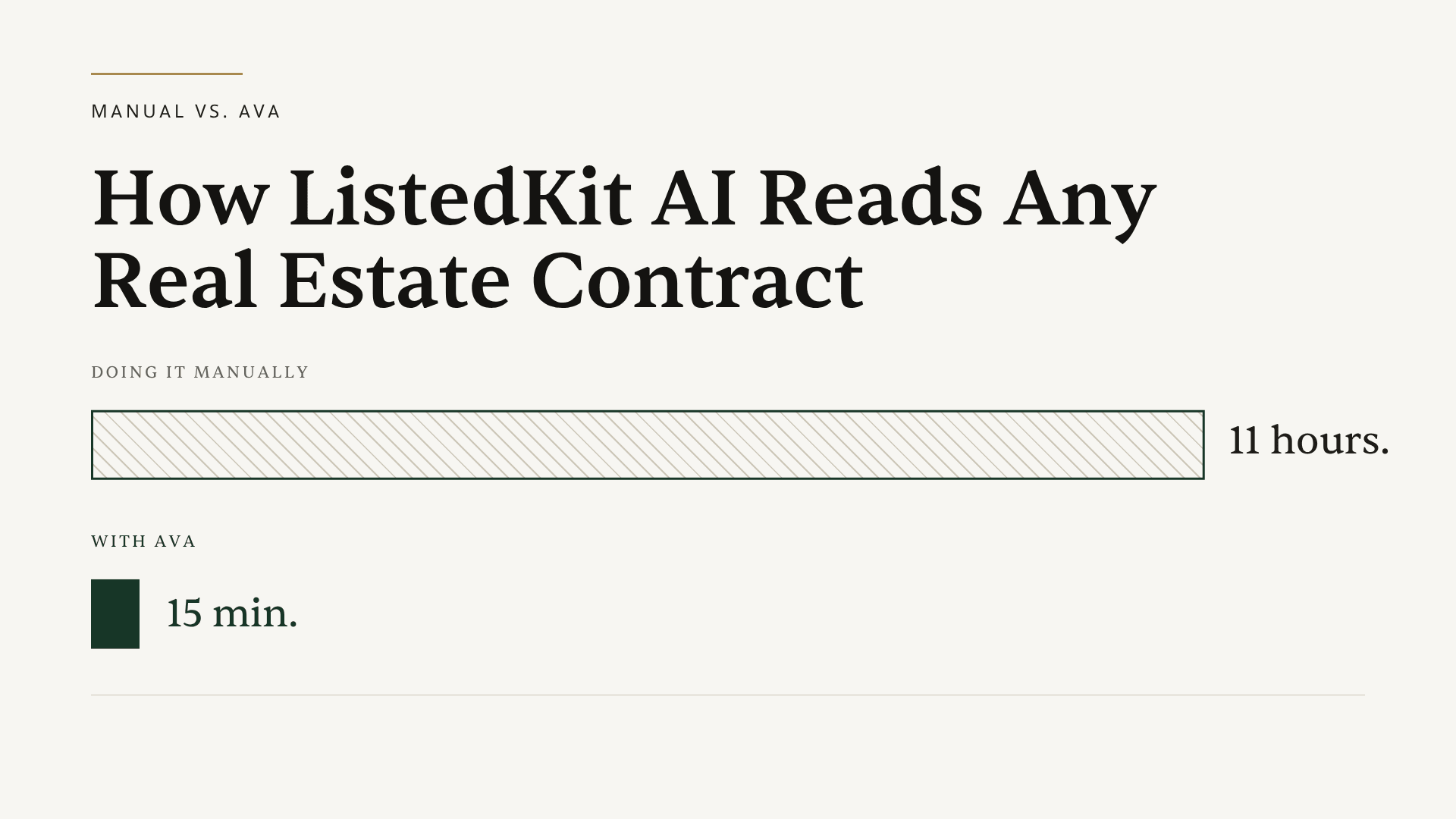
Say you're processing 15 transactions per month. That's a reasonable volume for a solo TC. If you're spending 30-45 minutes on intake for each file, that's 7.5 to 11 hours per month just on reading contracts and entering data. Not managing the transactions. Not communicating with clients. Not tracking deadlines. Just intake.
Cut that to 60 seconds per file with AI, and you're looking at 15 minutes total. You just got back 7-10 hours.
What do you do with that time?
Some TCs take on more files. If intake was your bottleneck, you might be able to handle 20 or 25 transactions instead of 15. At $300-500 per transaction, that's significant income.
Other TCs use the time to provide better service. More proactive communication. Faster response times. The kind of attention that turns one-time clients into referral sources.
And some TCs, honestly, just use it to stop working evenings and weekends. To pick up their kids from school. To have dinner with their family. To remember why they started this business in the first place.
The point is, the capacity ceiling created by manual data entry disappears. Your growth is no longer limited by how fast you can type.
Research from AgentUp shows that 98% of agents working with transaction coordinators close more deals per month compared to those who don't. But here's the thing: for TCs to support more agents, they need systems that scale. AI contract reading is one of those systems.
What About Accuracy? Can You Trust It?
This is the question everyone asks, and it's the right question to ask.
The honest answer: AI contract reading isn't perfect, and anyone who tells you it never makes mistakes is selling you something. But the relevant comparison isn't AI versus perfection. It's AI versus manual entry by a human who's done the same task hundreds of times and might be a little tired, a little distracted, or moving a little too fast because there are five more files waiting.
Humans make errors. According to quality control research across industries, manual data entry error rates typically range from 1-4%. That might not sound like much until you remember that a single transposed digit in a closing date can blow a deal.
AI systems making the same kind of systematic, reliable errors is actually easier to catch and correct than random human errors. When AI misreads something, it tends to misread similar things in similar ways. You learn what to double-check. With human entry, errors can appear anywhere, in any field, at any time.
The best approach is verification, not blind trust. Ava and similar systems present extracted data for your review. You scan through, confirm the critical fields, and approve. It takes a minute or two, versus the 30-45 minutes it would take to enter everything manually. And you're reviewing with fresh eyes, not entering data while simultaneously trying to verify it.
Most TCs using AI contract reading report that they catch more errors than they did with manual entry. Not because the AI makes more mistakes, but because reviewing extracted data is cognitively different from entering it. When you're typing, your brain is focused on the mechanics. When you're reviewing, you can actually think about whether the numbers make sense.
The New Baseline for Professional TCs
Here's the thing about technology adoption in any industry: early adopters get a competitive advantage, but eventually the technology becomes table stakes.
Right now, AI contract reading is still an advantage. TCs using it can handle more volume, respond faster, and deliver better service than those still doing manual intake. But that window won't stay open forever.
Over 66% of commercial real estate firms have already shifted toward automation for document processing and lease tracking. The residential side is following fast. As more TCs adopt AI tools, the expectation from agents and brokerages will shift. Manual intake will start to look slow, error-prone, and frankly, a bit outdated.
The TCs who thrive in this environment won't be the ones who work the hardest or type the fastest. They'll be the ones who adopt tools that multiply their capabilities. Who use AI to handle the mechanical work so they can focus on the judgment, relationships, and expertise that actually require a human.
AI contract reading is one piece of that puzzle. But it's a foundational piece. Everything else in transaction management, the deadline tracking, the communication, the document management, all of it flows from accurate data. Get the intake right, get it fast, and the rest of the transaction runs smoother.
The Bottom Line
AI contract reading isn't about replacing TCs. It's about removing the part of the job that never required human intelligence in the first place. You didn't become a transaction coordinator because you love manual data entry. You became one because you're good at managing complexity, solving problems, and keeping deals on track.
Let the AI read the contracts. You do the work that actually matters.