Best Practices
How to Grow a TC Business Without Adding Headcount
How to Grow a TC Business Without Adding Headcount
The ceiling on most TC businesses is not the market. It is the number of deals one person can manage before something drops. Most transaction coordinators hit that ceiling somewhere between 15 and 25 active files, and the conventional solution is to hire another TC. But hiring adds fixed cost, training overhead, and a new layer of quality control to manage. It trades one capacity problem for three operational ones.
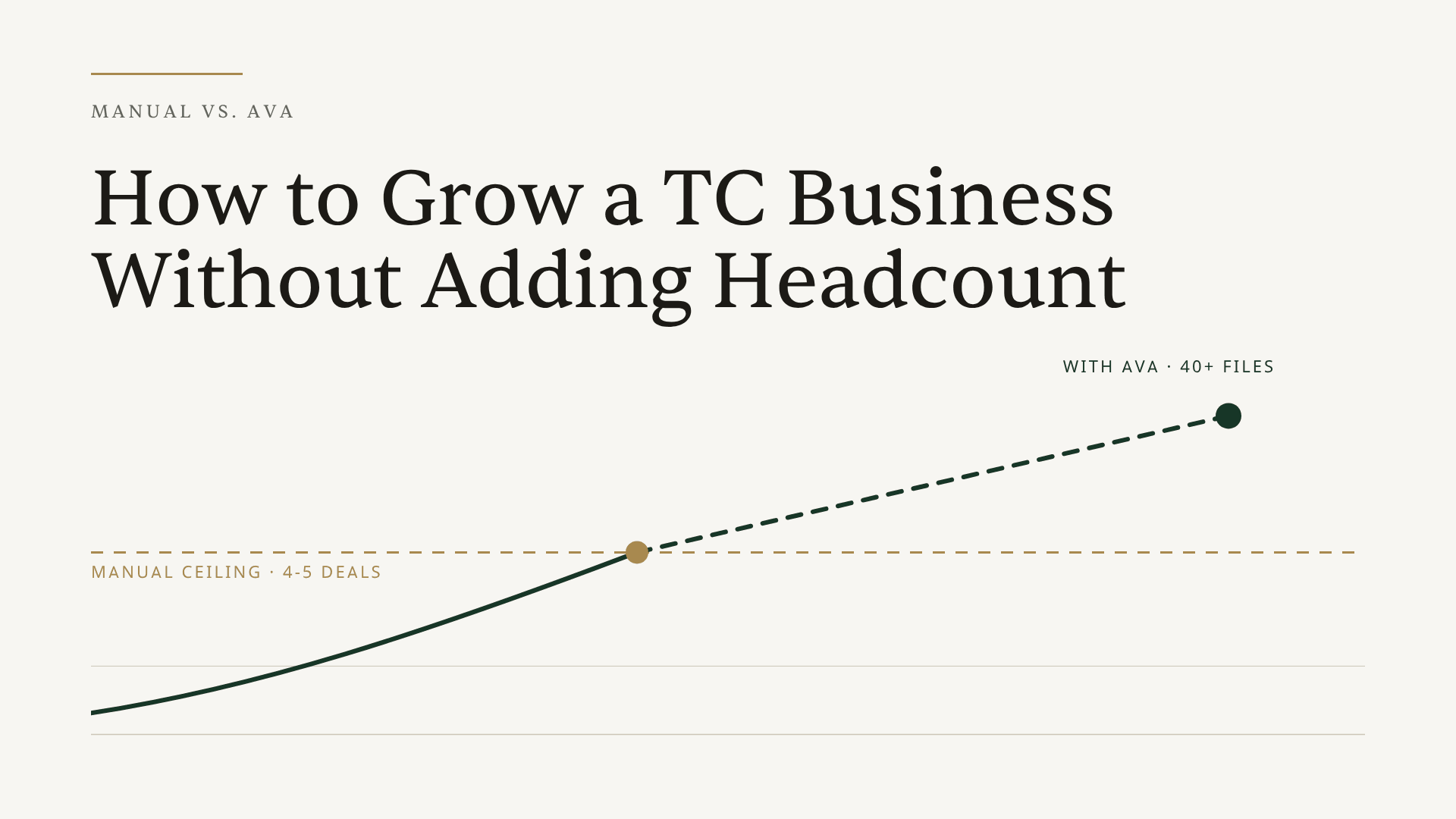
A different approach is gaining ground among high-volume TCs: use AI to remove the manual work that created the ceiling in the first place, rather than adding a human to absorb it. One transaction coordinator told us they went from 4 to 5 deals a month to 40 to 50. The growth did not come from hiring. It came from changing what they personally had to do for each deal.
The lever behind this is AI transaction coordination, where software handles the repetitive intake and deadline work so your people can take on more files.
That shift is what this article is about. Not theory, but the specific manual work that limits TC capacity, why those tasks are the ones AI handles best, and what the growth trajectory actually looks like for TC businesses that have made the change.
What actually limits TC capacity (it is not what most people think)
When TCs describe hitting their limit, they usually frame it as a volume problem. Too many files, not enough hours. But when you look at where the hours go, the pattern is consistent: the constraint is not deal management. It is intake.
Every new transaction starts the same way. The executed agreement arrives. The TC reads it, manually extracts every date and party, builds the timeline for that state's form, enters everything into their system, and then starts triaging the emails that came in while they were doing that. For a thorough TC, that intake process runs 30 to 45 minutes per deal. Some TCs described it as closer to an hour for complex contracts.
At 20 active files, that intake load is a constant drain. At 30 files, it starts to crowd out the actual transaction management. At 40 files, it becomes unsustainable without either working longer hours or dropping quality somewhere.
The deal management work, following up on contingencies, coordinating parties, tracking deadlines, drafting communications, is not where TCs lose time. That is the work they are good at and that clients are paying for. The intake is the tax on doing that work.
Any growth model for a TC business that does not address the intake problem is just redistributing it to a hire. The question is whether you can remove the tax instead of hiring someone to pay it.
The three intake tasks that Ava takes off the list
There are three specific tasks that make up the majority of the intake burden for most TCs, and all three are tasks AI handles well because they are structured, repeatable, and do not require judgment.
Contract extraction. Reading a purchase agreement and pulling out every date, party, and contingency is work that follows a pattern. The dates are in specific fields. The parties are named in specific clauses. The contingencies follow a structure that varies by state but is consistent within it. Ava reads any purchase agreement (CAR, TREC, regional MLS forms, custom brokerage templates) and extracts every field automatically. No templates to configure. No state-specific setup. One TC put it this way: they can do so much more because Ava reads the contracts for them and extracts every piece of information, including details the agents did not even notice were included.
Across more than 5,600 contracts Ava has processed, that extraction work totals more than 40,000 individual fields. Each of those is a field a TC used to pull by hand.
Email triage. The inbox problem is underrated. Every active deal generates a stream of emails: lender updates, title confirmations, agent questions, buyer inquiries. Many of them arrive with ambiguous subject lines, no property address, or forwarded thread context that makes them hard to place at a glance. Triaging that inbox, figuring out which email belongs to which deal, takes real time and real focus at high volume. Ava monitors incoming emails and matches each one to the right deal file by context, not just subject line. When a TC opens their laptop in the morning, every email from the past 12 hours is already in the right file. The triage did not happen because it did not need to.
Timeline building. After the contract is read and the dates are extracted, someone has to build the timeline: the checklist for this deal type, in this state, with these specific dates and these specific parties. Ava builds it automatically from the contract. California's contingency windows, Texas closing timelines, Florida escrow rules, all handled without state-specific templates or manual date entry.
These three tasks, contract extraction, email triage, and timeline building, are where TC capacity goes. Remove them from the daily workflow and the deal management work that is left scales differently.
What happens when TCs stop paying the intake tax
Once a TC experiences automated intake, the behavior change is permanent. Not because the tool creates lock-in, but because the alternative stops making sense. Spending 45 minutes extracting dates and party names from every new contract, when those 45 minutes could go to client relationships or the next deal, is a trade no one makes twice.
This is what AI transaction coordination does in practice: it carries the intake and deadline tracking so the ceiling on your file count moves up.
The growth arc from there is consistent. In the first month, active file capacity roughly doubles as intake time drops from 30 to 45 minutes per deal to 5 to 10. The TC is now managing 30 or 35 files with the same hours they were spending on 20. In months two and three, the ceiling moves again: instead of managing at capacity, they are growing toward it. New client relationships get a yes instead of a "let me check my bandwidth." By month six, teams that used to cap at 20 files are running 40 or more.
The economics follow naturally. At $14.99 per intake, adding 20 more deals a month costs $300, against the agent fees on 20 additional closings. The business grows faster than the cost of enabling it.
The most important signal is what the freed capacity gets directed toward. The hours that used to go to extraction go to growth: new agent pitches, referral follow-ups, the next deal instead of the question of whether there is bandwidth for it. That posture change is what a growing TC business looks like.
How this changes what growth looks like operationally
For a TC business owner, scaling from 20 files to 40 without hiring is one challenge. Scaling from 40 to 100 with a small team is a different one. The bottleneck moves but it does not disappear.
At the team level, the same intake leverage applies, but with an additional dimension: consistency. When multiple TCs are running deals, quality variation becomes a real risk. The TC who is organized and meticulous runs deals one way. The TC who is newer or managing a heavier load runs them differently. Clients notice the difference, and inconsistency is one of the fastest ways to lose agent relationships.
Ava provides a consistent intake standard across the whole team. Every TC runs the same first step on every deal: contract uploaded, Ava extracts, timeline built, inbox matched. The variation in that step goes to near zero. What TCs do with the extracted information can still vary, but the information itself is complete and consistent from intake.
This matters for onboarding, too. A new TC joining a team using Ava is productive on day one. They do not need to learn which template to use for which state, or how to triage the inbox from scratch. Ava handles the structured work and the new TC focuses on the judgment calls immediately. The ramp time that usually costs a TC business owner weeks of supervision compresses to days.
One TC business owner described their team's current state as "drastically expanding." The capacity that was limited by intake overhead is now available for the relationship and judgment work that builds the client roster.
The practical steps to shift to this model
If you are running a TC business at the ceiling right now, the transition is simpler than most expect.
The first step is running your next intake in Ava. Your first transaction is free. If you want to evaluate Ava against other tools before you start, our AI transaction coordinator software guide runs through the four criteria that separate real AI from task management software with an AI badge. Upload the executed purchase agreement, connect your Gmail, and see what Ava extracts. The concrete comparison, what you would have done manually against what Ava did automatically, is the fastest way to make the decision real.
The second step is tracking your actual intake time before and after. Most TCs who do this are surprised by the gap. Thirty to 45 minutes per intake across 20 active files is 10 to 15 hours a week, every week. That time, redirected to client work and business development, is the growth engine.
The third step is adjusting your capacity ceiling. If you were capping new clients because you were at 20 files, and intake now takes 5 minutes instead of 45, the ceiling has moved. Taking on two more agent clients does not require more hours. It requires trusting that the intake infrastructure holds. The 84% same-day adoption rate and the 65% repeat-deal rate are the evidence that it does.
If you have a team, the fourth step is standardizing on Ava as the intake workflow. Every TC on the team runs every deal the same way. The consistency compounds: clients get the same quality from every TC on your team, every time, and you stop being the person who spot-checks everything. For teams managing high deal volume, our high-volume TC guide covers the operational patterns that support 100+ deals a month.
What the ceiling actually looks like when it moves
There is a before and after to this that is worth naming plainly.
Before: The ceiling is real. 20 to 25 active files at a time, 30 to 45 minutes per intake, inbox triage on top of that, and a constant sense that one more deal could tip the balance. The solution most TCs reach for is working longer, saying no to new clients, or hiring.
After: The intake work runs in the background. The TC opens their laptop to deals that are already organized, timelines that are already built, and emails that are already sorted. The 10 to 15 hours a week that went to structured extraction work is available for the high-judgment TC work that actually requires them. Active file capacity doubles, not because the TC works harder, but because the work they were doing by hand does not need to be done by hand anymore.
The real estate professional who described this most directly said it is not a matter of if you are going to use AI in your TC business, it is a matter of how you are going to optimize it. That is the posture of someone who has already moved past the ceiling question. The constraint is no longer how many files they can handle. It is how quickly they can grow their client base.
Try it on your next intake
Your first transaction is free at app.listedkit.com. Connect Gmail, upload the purchase agreement, and Ava will show you every date, party, and contingency she found, along with the timeline she built. The comparison between that and what you would have built manually is the clearest argument for the model.
If you are evaluating this for a team, the same first transaction applies to every TC on your team individually. The onboarding is the first deal. There is nothing to configure before it runs.