Best Practices
How to Catch Compliance Issues Before Your Broker Does
The compliance issues that delay closings aren't the ones you know about. They're the ones hiding on page 12 of a 40-page contract.
How do TCs handling 20+ files a month keep compliance errors from slipping through when a single missed field on an addendum can delay closing by a week?
It's not spending 45 minutes per file flipping through every page. It's knowing exactly which four types of compliance errors cause the majority of closing delays, and having a system that catches them before they ever reach the broker's desk. According to the NAR REALTORS Confidence Index, 11% of contracts encounter delays and 6% are terminated outright. Many of those delays trace back to document compliance issues that should have been caught days or weeks earlier.
This guide breaks down the 4 real estate compliance issues that actually delay closings, why manual review misses them even when you're experienced, and how AI compliance automation is changing the game for transaction coordinators in 2026.
The 4 Compliance Issues That Actually Delay Closings
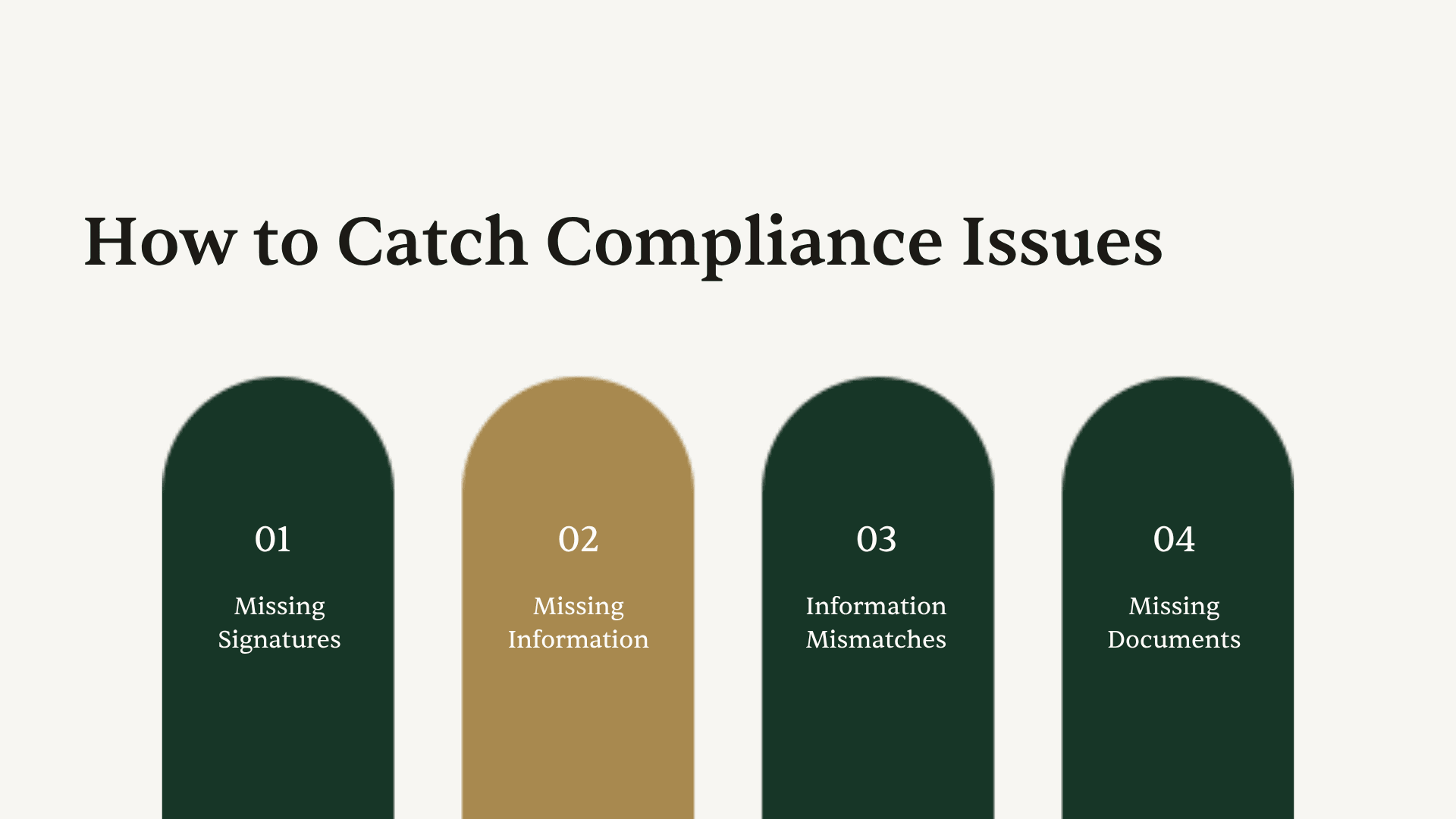
Most TCs think of "compliance" as checking boxes. Making sure the right forms are in the file, signatures are in the right spots, dates look about right. But the compliance issues that actually blow up deals are subtler than that. They fall into four categories, and understanding the difference between them is the first step to catching them consistently.
1. Missing Signatures
This is the one everyone thinks about first, and for good reason. Unsigned signature blocks, missing initials on individual pages, addenda that never got signed by all parties. It sounds basic, but it keeps happening.
Here's a real example from CRES Insurance: a single missed initial on an addendum page delayed a closing by four days. That delay caused the buyer's rate lock to expire, costing an additional $3,700 to extend. One initial. $3,700.
The tricky part isn't the main signature block at the end of the purchase agreement. Most people catch that. It's the initials scattered across individual pages, the acknowledgment forms that need all parties to sign separately, and the addenda that were added mid-negotiation and somehow never made it back to the listing agent for signatures.
2. Missing Information
Blank fields are the "obvious" errors that somehow get missed because everyone assumes someone else filled them in. Purchase price left blank on an addendum. Closing date missing from a form. Earnest money amount not entered. Property legal description incomplete.
You'd think these would jump off the page. But when you're processing your fifteenth file this week, your eyes start skipping over the fields you expect to be filled in. You see the form, you recognize it, and your brain fills in the blanks before you actually verify they're there. It's a cognitive shortcut that works great for experienced TCs, right up until it doesn't.
3. Information Mismatches
This is the sneaky one. Every field is filled in. Every signature block is signed. Everything looks complete. But the closing date says March 15 on the purchase agreement and March 18 on the second addendum. The buyer's last name is spelled "Thompson" on the contract and "Thomspon" on the disclosure. The purchase price on the lender's pre-approval doesn't match the contract price because there was a counteroffer nobody updated.
Information mismatches are where deals really unravel. Title companies catch them at the last minute, causing frantic scrambles to get corrected documents signed. Or worse, nobody catches them until the closing table, and everyone's sitting there while the TC is on the phone trying to get a corrected addendum signed and notarized.
When you're working in states like California with 12+ disclosure forms, or attorney states like New York with their own layers of documentation, the surface area for mismatches multiplies fast.
4. Missing Documents
The silent killer. A document is referenced in the contract but never uploaded to the file. The inspection contingency deadline passed, but there's no inspection report in the system. HOA documents were required per the contract terms, but nobody ever requested them from the management company.
Missing documents are different from the other three because you can't catch them by reviewing what's in front of you. You have to know what should be there and notice its absence. That takes a different kind of attention, one that requires cross-referencing the contract terms against your transaction coordinator checklist and document tracker.
The worst part? You often don't discover a missing document until the deadline has already passed. And at that point, you're not just dealing with a compliance issue. You're dealing with a potential breach of contract.
Why Manual Review Misses These (Even for Experienced TCs)
Here's the uncomfortable truth: experience can actually make you more likely to miss compliance issues, not less.
When you've reviewed hundreds of California PRDS forms, your brain starts pattern-matching instead of reading. You see the familiar layout, the standard paragraphs, the usual signature blocks. Your eyes glide over the form at speed because you "know" what it says. That's great for efficiency. It's terrible for catching the one field that's blank this time when it's always been filled in before.
The numbers back this up. Each real estate transaction involves an average of 45 hours of work, and 30 of those hours are purely paperwork. At 20 files per month, that's 600+ hours annually spent on documents. At 30 files, it's 900 hours. Nobody maintains laser-sharp attention for 900 hours of document review per year. Nobody.
And counteroffers make everything worse. When you have a purchase agreement, two counteroffers, and an addendum, you need to follow the logic chain across all four documents to determine which closing date, which price, and which contingency periods are actually final. The last counteroffer might reference "all other terms remain the same," but did it? Or did Counteroffer #1 change the inspection period, which Counteroffer #2 didn't explicitly address? Following that thread across multiple documents is exactly where mismatches creep in.
Then there's the volume problem. The difference between AI-powered review and basic automation isn't just speed. It's that AI can actually read and understand the content of documents, not just check whether a file has been uploaded.
State complexity adds another layer. California's disclosure requirements alone could fill a binder. Attorney states like Connecticut, Massachusetts, and South Carolina add mandatory legal review that creates more documents and more places for errors to hide. And starting March 2026, the new FinCEN Residential Real Estate Rule will require additional reporting on non-financed transfers to legal entities, adding yet another compliance checkpoint TCs need to manage.
Here's what a lot of TCs don't realize about broker compliance audits: by the time your broker catches an issue, the damage is already done. The broker audit isn't a safety net. It's a report card. If your broker finds a missing signature or a date mismatch during their review, that error already existed in a file that may have already closed. And if it delayed closing? That's on your record, not theirs.
As WAV Group noted in their 2026 AI infrastructure report, "forms are where risk, accuracy, and efficiency converge." They found that 49% of brokerage leaders rate their concern about compliance and AI guardrails between 7 and 10 on a 10-point scale. The industry knows this is a problem. The question is what to do about it.
How AI Compliance Scanning Actually Works
Let's be clear about what AI compliance scanning is and isn't. It's not keyword matching. It's not a template that checks whether files have been uploaded. And it's not a simple automation that flags forms missing from a pre-built list.
Real AI compliance scanning works in three layers.
Layer 1: Document Reading. The AI reads the actual content of every document in the transaction file. Not just the file name or the form type, but the text on every page. It extracts every field, every signature block, every date, every name, every dollar amount. It handles typed text, handwritten entries, and even messy counteroffers with cross-outs and marginal notes.
Layer 2: Cross-Referencing. This is where it gets powerful. The AI compares what it extracted against the existing transaction context. Does the closing date on the new addendum match what's already in the system? Does the buyer's name on the disclosure match the purchase agreement? Is the earnest money amount consistent across all documents? It's checking every data point against every other data point, across every document in the file.
Layer 3: Flagging. When the AI finds an issue, it tells you exactly what it found and where. Not "there may be an issue with Document 3." Instead: "The closing date on the Seller's Counteroffer (page 2, paragraph 4) is March 18, but the purchase agreement shows March 15." Specific enough to act on immediately.
This three-layer approach is why AI compliance scanning catches things that manual review misses. A human reviewer might catch a blank signature block on the page they're looking at. But they're not simultaneously comparing the closing date on that page against the closing date on the addendum they reviewed ten minutes ago. The AI is.
The industry is moving this direction fast. Restb.ai launched AI-powered document compliance scanning for MLS forms in 2025. Inman covered how ListedKit is applying AI to the entire transaction management workflow. The tools exist. The question for most TCs isn't whether AI compliance scanning works. It's whether they can afford not to use it.
What Ava Catches Automatically
This is where ListedKit's AI assistant, Ava, fits into the picture. Ava's Compliance Check acts as a second set of eyes on every document you upload, scanning for all four types of compliance issues automatically.
Missing Signatures: Ava catches unsigned signature blocks and missing initials before they become closing delays. She knows which pages require signatures and which parties need to sign, based on reading the actual document content.
Missing Information: Ava identifies blank fields that need to be filled in. Purchase price, closing date, earnest money, property details: if a required field is empty, she flags it immediately.
Information Mismatches: This is where Ava really shines. She detects discrepancies between new documents and the existing transaction context. If the closing date on an addendum doesn't match what's already in the file, she catches it. If a name is spelled differently across documents, she catches it. If financial figures don't align, she catches it.
Missing Documents: Ava's document tracking gives you a one-stop view showing document status across all your transactions: missing, has issues, or fully executed. She surfaces deadlines at risk when required documents haven't arrived, so you're never surprised by a gap in the file.
And she does all of this in seconds, not the 20-30 minutes it takes to manually review a file. Ava reads any state's purchase agreement in real time, handles handwritten contracts, and follows logic across multiple counteroffers to find the final terms.
TCs who use it say it best. One user called compliance scanning a "huge, huge" benefit. Another said having a second set of eyes on compliance is "always good to have." And when one TC saw the document compliance feature for the first time during a demo, their reaction was simple: "That's nice. Oh, that's really nice."
The point isn't that Ava replaces your judgment. You're still the expert on your transactions. The point is that she catches the things your eyes skip over on file number 23 of the month, the mismatch on page 12 that you'd normally catch on file number 3 but not when you're running on caffeine and a deadline.
Brokers reach this from a different angle. The question is less which steps to automate and more what is happening across every agent’s files at once. For that view, see what a broker can see across every agent’s files.
The Bottom Line
The compliance issues that delay closings aren't the ones you're already watching for. They're the mismatched dates on page 12, the blank field on the addendum, the document that was referenced but never uploaded. A systematic approach to real estate compliance automation catches them. AI catches them faster. And catching them before your broker does is the difference between being the TC who never lets things slip and the one getting the call nobody wants to get.