Best Practices
The TC Capacity Ladder: 10 to 100 Deals/Month
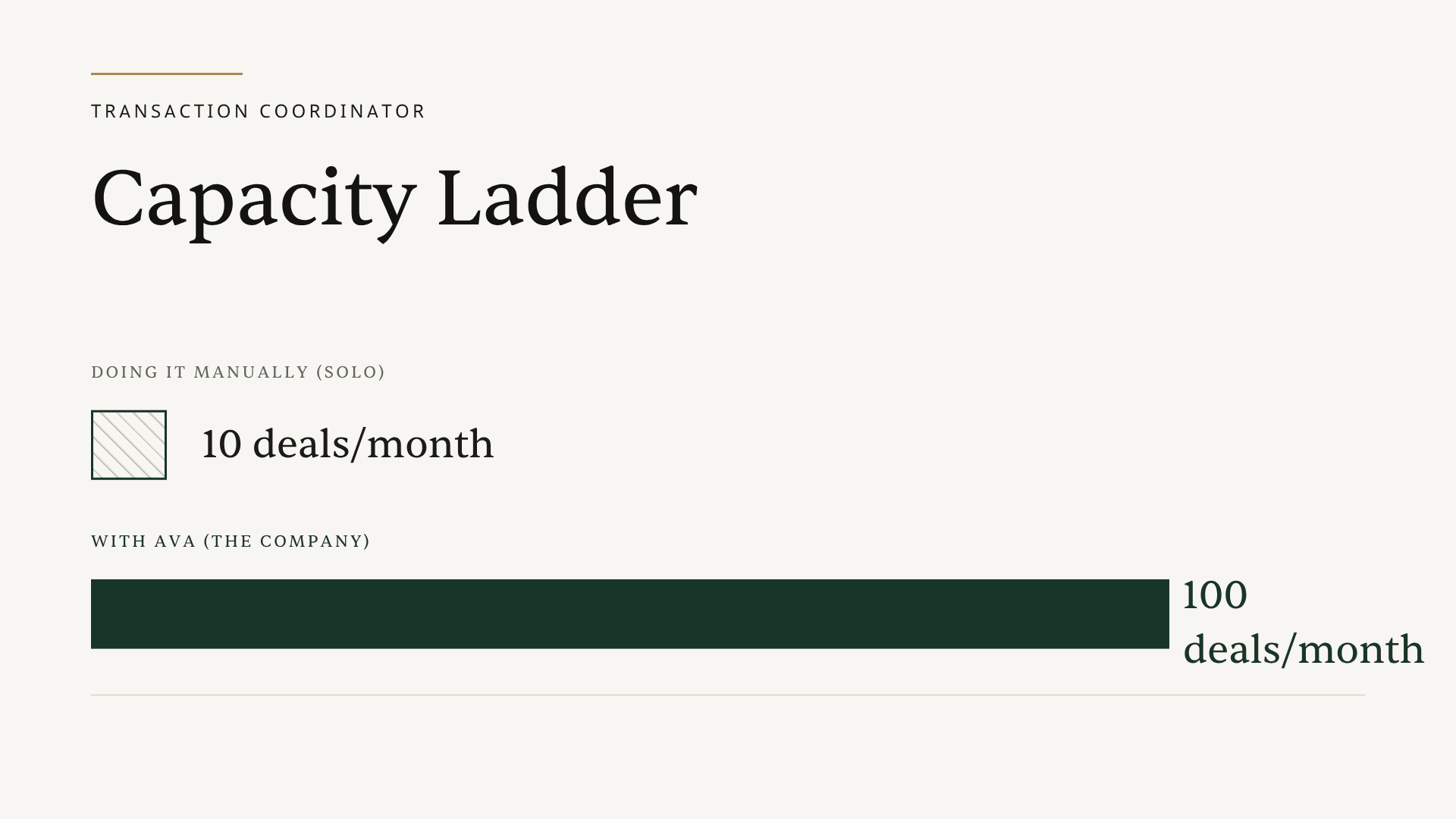
From 4 deals a month to 40. That's what Ava enables.
That's not a marketing line. It's what a TC told us directly, and it captures something real about what's possible when you stop doing coordination manually and start doing it with a teammate who doesn't clock out.
But here's the thing most TC business advice misses: scaling a transaction coordination business isn't just about doing more of the same thing faster. Each growth tier looks different. The tools you need change. The failure modes change. The way you price, hire, and position your business changes. What works at 10 deals a month breaks at 25. What works at 25 doesn't survive 50.
This article walks through each rung of the capacity ladder - 10, 25, 50, and 100 deals per month - so you can see exactly where you are, what's coming, and how to cross each threshold without burning out or dropping the ball.
Rung 1: 10 Deals a Month (The Solo Grind)
What the operation looks like
At 10 deals a month, you are the operation. You're doing intake, building checklists, tracking deadlines, drafting emails to escrow and lenders, following up on missing documents, and fielding calls from agents who want status updates. You're good at this. You have systems, probably in a spreadsheet or a basic transaction management tool, and you know where every file stands at any given moment.
Your revenue is in a solid range. Independent transaction coordinators typically charge $350 to $450 per transaction on the buyer or seller side, with some markets running $500 to $600 for full-service files. At 10 deals, you're doing $3,500 to $6,000 a month in gross revenue. It's a real business, but it's completely dependent on your personal bandwidth.
Your client base is probably 3-5 agents, and most of your new business comes from referrals or repeat clients. You haven't had to market yourself much, because word of mouth at this volume is enough.
What changes when you push toward 25
The shift from 10 to 25 isn't just adding files. It's a 2.5x jump in cognitive load. At 10 deals, you can hold all the context in your head. You know which file is waiting on the inspection contingency and which one has a lender who's slow to respond. At 25, that mental model collapses. You will miss something. The question is whether you have systems in place before you do.
At this tier, you also start attracting different clients - higher-volume agents who are themselves managing 5-10 transactions at a time. They need a TC who can keep up, respond fast, and be proactive. They're not going to tolerate a 24-hour email turnaround when a contract is about to expire.
What breaks first
The first thing that breaks is your intake process. When a new file drops, you have to read the contract, extract dates and parties, build a task list, and send initial emails to all parties. If you're doing that manually, it takes 45 to 90 minutes per file. At 10 files a month, that's manageable. At 25, you're spending two full days a month just on intake before you've done any actual coordination.
The second thing that breaks is follow-up. When you have 25 active files, keeping track of which document is outstanding, which party hasn't responded, and which deadline is 3 days out requires a system that runs itself. Relying on calendar reminders and mental notes doesn't scale.
How Ava helps at this rung
Ava reads the contract the moment it comes in, extracts key dates, parties, and contingencies, and builds the transaction file automatically. What took you 60-90 minutes of intake work drops to a few minutes of review. She then tracks deadlines and surfaces what's coming up, so you're not managing your calendar manually across 25 files.
That time savings is the capacity multiplier. One TC we work with described it this way: Ava freed her up from the administrative weight of intake so she could spend her time on actual coordination, the calls, the judgment calls, the relationship management that agents actually pay for.
Ready to see how Ava handles intake and deadline tracking across your whole pipeline? Your first transaction is free - no commitment, no setup fee.
Rung 2: 25 Deals a Month (The Systems Test)
What the operation looks like
At 25 deals a month, you are running a real TC business. You're billing $8,750 to $15,000 a month gross, you have a steady roster of agent clients, and you've started to think about your business more strategically. You might have a VA helping with some administrative work, or you're seriously considering it.
Your workflow has matured. You probably have a dedicated transaction management platform, standardized email templates, and a checklist structure you've refined over dozens of files. The chaotic early days of figuring out the process are behind you. Now the challenge is maintaining quality as volume grows.
Clients at this tier expect proactivity. They don't want to call you for updates, they want updates before they need to ask. That expectation is manageable at 25 files if your systems surface the right information at the right time, but it's impossible to meet by memory alone.
What changes when you push toward 50
Fifty deals a month is where most solo TCs hit a hard ceiling. You physically cannot manage 50 active files without either a teammate or a tool that does a significant portion of the work for you. According to industry benchmarks, a full-time TC with good tools can handle 20 to 60 files per month, and the higher end of that range only becomes accessible when the administrative overhead is dramatically reduced.
That drop in overhead comes from AI transaction coordination, which reads the contract and builds the file so each new deal adds far less work.
At 50, you also start facing pricing pressure from agents who want to consolidate their TC relationship. A high-volume agent doing 20 transactions a month wants to pay per file, they want a consistent experience, and they want you to be available when they need you. That's a different service model than serving 10 different agents each doing 2-3 deals.
What breaks first
At 25, the first thing that breaks is your email management. TCs at this volume typically send hundreds of emails a week: updates to lenders, requests to escrow, reminders to agents, status checks with title companies. If you're writing or significantly editing each email individually, you're spending hours every day on correspondence that doesn't require your expertise, it requires your attention.
The second failure mode is status communication. As your agent clients grow, they want visibility into their files without having to call or email you. At 25 files, you can keep up with inbound status requests. At 35 or 40, you can't respond to every check-in quickly enough to meet expectations, and you start looking reactive instead of on top of things.
How Ava helps at this rung
Ava drafts outbound emails for each transaction based on context from the file: the parties involved, the current stage of the transaction, and the next deadline coming up. You review and send, but you're not writing from scratch. That shift alone recaptures hours of time per week.
She also surfaces a real-time view of every active file, so when an agent calls for an update, the answer is immediate. No searching through email threads or spreadsheets. And because she's tracking deadlines automatically, the proactive check-ins go out before the agent has to ask.
This is where the capacity multiplier becomes most visible. With Ava handling the administrative layer, you stay at the center of each transaction, handling the judgment calls and relationships, while she manages the logistics. One TC told us her business was expanding by leaps and bounds once she stopped doing the administrative work manually. That's not an accident. It's what happens when your time goes toward coordination instead of administration.
Rung 3: 50 Deals a Month (The Team Threshold)
What the operation looks like
Fifty deals a month is a serious TC operation. At $350-$450 per transaction, you're looking at $17,500 to $22,500 a month in gross revenue, closer to $25,000+ if your market commands higher per-file rates. You're not a freelancer anymore. You have a business.
At this volume, you almost certainly have at least one other person involved, whether that's a part-time VA, a junior TC, or a contracted team member. Your process is mature. You have standard operating procedures. You've got multiple agent relationships that send you consistent volume, and probably a few brokerage-level clients who refer you regularly.
The operational question at this rung is no longer "can I do this" - it's "can I do this consistently, at quality, without burning out the people on my team."
What changes when you push toward 100
One hundred deals a month is a TC company, not a TC business. At that volume, you need real team infrastructure: role clarity, quality controls, a way to onboard new team members without sacrificing consistency, and pricing that reflects the service level you're delivering.
Getting from 50 to 100 requires you to stop being the primary coordinator on every file. That's a significant shift. Your job becomes building and managing the system, not running each transaction yourself. And that only works if the system is reliable enough to trust.
What breaks first
At 50, the first thing that breaks is quality control. When multiple people are touching files, inconsistency creeps in. One team member handles a lender follow-up differently than another. Deadline communication goes out with slightly different tone. An agent who used to work exclusively with you starts noticing that the experience feels different depending on who's handling their file.
The second failure mode is onboarding. Bringing a new team member up to speed at 50 files a month is hard. Every transaction is different, the tools are complex, and there's no time to train in depth. Most TC business owners at this tier spend too much time supervising instead of growing.
How Ava helps at this rung
Ava creates consistency across every file regardless of which team member is coordinating it. She reads each contract the same way, builds the same structure, tracks deadlines with the same reliability. That consistency is what makes it possible to bring on new team members without sacrificing quality.
She also reduces the supervision burden. When Ava is handling intake, deadline tracking, and email drafting, new team members have a shorter ramp time. The heavy administrative work is handled by the tool. Your team focuses on coordination and relationships, which is the part that actually requires training and judgment.
This is where the best TC software becomes a strategic asset rather than just a productivity tool. You're not buying efficiency, you're buying scalability.
Want to see what a 50-deal operation looks like when Ava is handling the administrative layer? Your first transaction is free.
Rung 4: 100 Deals a Month (The Company)
What the operation looks like
One hundred deals a month is a different business entirely. You have a team. You have recurring brokerage relationships. You may have multiple service tiers: coordinating only, versus full intake plus deadline management plus email correspondence. Your revenue is in the $400,000+ annual range depending on your per-file rates, and you're thinking about margin, not just revenue.
At this volume, the personal brand you built as a solo TC isn't the primary driver anymore. The company's reputation is. Your systems, your quality controls, your team's reliability - that's what agents and brokerages are buying.
What changes at this rung
Pricing evolves at this level. You may move some brokerage relationships to retainer or volume-based pricing instead of per-file. That creates more predictable revenue but requires a different conversation with clients.
You're also making real hiring decisions. Not "should I bring on a VA" but "do I need a junior TC, an ops coordinator, and a client-facing account manager." Your cost structure is more complex, and your margins require active management.
What breaks first
The most common failure mode at 100 deals is a loss of client-level visibility for the business owner. When 100 transactions are active at once, you can't personally track the status of each file. If something goes wrong on a file, you may not hear about it until the agent is already frustrated.
The other failure mode is pricing your team incorrectly. At lower volumes, you can absorb some inefficiency in labor costs. At 100, sloppy time management across the team directly compresses margin.
How Ava helps at this rung
At 100 deals a month, Ava's value is primarily operational leverage. She handles the intake and administrative layer across all 100 files consistently, which means your team is almost entirely focused on coordination and client management rather than administrative processing. That's how you maintain quality at scale without proportionally increasing headcount.
The math is straightforward. If each file requires 2 hours of administrative work (intake, email drafting, deadline setup) and Ava reduces that to 20-30 minutes of review, you're saving roughly 90 minutes per file. Across 100 files, that's 150 hours a month. At any reasonable hourly cost for your team, that's a significant reduction in labor expense per file.
That's how you grow from 50 to 100 deals without hiring proportionally.
Pricing Your TC Business as You Scale
One of the biggest mistakes TCs make when scaling is keeping their per-file pricing flat as their service level improves. Here's a realistic picture of the market in 2026:
The national average for independent TC services runs $350 to $450 per transaction, with higher-end markets and full-service models pushing $500 to $600 per file. Pricing has drifted up 10-20% since 2023, reflecting both increased file complexity and higher market rates for quality coordination.
If you're still charging 2022 rates in 2026, you're working harder for the same margin. The TCs who scale successfully tend to raise rates as their systems improve and as they can demonstrably show faster response times, fewer errors, and more consistent communication. That's a service quality argument, not just a market rate conversation.
At 50+ files, some TCs begin packaging services differently: a standard tier for intake and deadline tracking, and a premium tier that includes proactive email drafting and full document management. That tiering lets you serve agents at different price points without doing the same work for every client.
For tools, ListedKit pricing is per transaction, not per seat — which means your cost scales linearly with volume, and you're never penalized for adding team members.
The Capacity Multiplier: Where Ava Fits in the Ladder
Each rung of the ladder has a different bottleneck, and Ava addresses each one specifically:
- At 10 deals: She handles intake so you can take on more files without more hours.
- At 25 deals: She manages email correspondence and deadline tracking so you stay proactive at volume.
- At 50 deals: She creates consistency across team members so quality doesn't degrade as you grow.
- At 100 deals: She provides operational leverage so your headcount doesn't scale proportionally with file count.
This is what "capacity multiplier" means in practice. You're not adding capacity by hiring more people doing the same work. You're adding capacity by having Ava do the administrative layer so your team's time goes to coordination, relationships, and judgment.
That's how a TC told us she went from 4-5 deals a month to 40-50. It wasn't about hiring more people. It was about changing what the people she had (including herself) actually spent their time on.
What Top-Performing TC Businesses Do Differently
Research and industry reporting point to a consistent pattern among TCs who scale successfully:
They build systems before they need them. The TCs who hit 50+ files without a breakdown set up their processes at 20 files, not at 45. They didn't wait until things started breaking.
They price for the next tier, not the current one. If you're at 15 deals and planning to be at 30, your pricing should reflect the service level of a 30-deal operation, not a 15-deal one. Clients who come in at the right price point are the clients who stay as you grow.
They choose a single aligned agent over three misaligned ones. A high-volume agent who refers consistently and communicates clearly is worth more than three agents who are sporadic and hard to work with. Quality of client mix matters as much as quantity.
They stop treating admin work as coordination. Intake, email drafting, deadline setup, document collection - this is administrative work. Negotiation support, agent communication, judgment calls on complex files - this is coordination. The TCs who scale are the ones who clearly separate the two and offload the first category.
Ready to Move Up the Ladder?
Whether you're at 10 deals trying to get to 25, or at 50 trying to build toward 100, the path is the same: reduce the administrative work that's consuming your capacity, create consistency across every file, and let your time go to the coordination work that actually requires you.
Ava is how you do that. She reads contracts, tracks deadlines, and drafts correspondence so you spend your hours on the work that moves your business forward.
Your first transaction is free. Try it on your next file and see what it does to your intake time.