Ai Automation
5 Ways AI Is Changing Transaction Coordination in 2026
What separates the TCs who'll thrive in 2026 from those scrambling to keep up?
It's not working more hours or memorizing more contract forms. The transaction coordinators pulling ahead this year understand a fundamental shift happening right now: AI isn't just a tool anymore. It's becoming a teammate.
Inman Connect New York 2026 kicks off February 3rd, and the buzz is impossible to ignore. Industry leaders, tech innovators, and thousands of real estate professionals will gather to discuss what's next. And if there's one theme dominating every conversation, it's artificial intelligence. According to Inman's 2026 predictions roundup, "AI will be the common thread driving the biggest changes in residential real estate" this year.
But what does that actually mean for transaction coordinators? Not the hype. Not the fear-mongering about robots taking jobs. The real, practical changes that will affect how you work, how much you earn, and whether you're positioned to grow or struggling to keep pace.
This guide breaks down the five biggest ways AI is changing transaction coordination in 2026, with data on what's actually working and practical steps to position yourself ahead of the curve.
If you are new to the idea, start with the basics of what AI transaction coordination is before looking at how it is shifting the role.
1. The Rise of Agentic AI: From Tools to Teammates
The biggest shift in AI for 2026 isn't faster processing or better accuracy. It's a fundamental change in how AI systems operate.
Traditional AI tools work like this: you give a prompt, the AI responds. You ask it to summarize a document, it summarizes. You ask it to draft an email, it drafts. Every action requires your instruction.
Agentic AI is different. These systems can plan, reason, and execute multi-step workflows with minimal supervision. According to HousingWire's analysis, agentic AI "doesn't just respond to prompts, it proactively manages transactions, qualifies leads, processes documents, and orchestrates end-to-end tasks."
Think about what that means for a typical real estate transaction. A single deal involves more than 170 discrete steps across communication, scheduling, compliance, documentation, and follow-up. Agentic AI systems are being designed to handle that entire workflow, from contract upload to closing coordination.
WAV Group's 2026 strategic report puts it plainly: "The real estate industry is entering a decisive window as agentic AI moves from novelty to infrastructure."
Now, here's the important nuance. Most AI tools available today, including the good ones, aren't fully agentic yet. They operate as copilots rather than autopilots. The AI does the heavy lifting (reading contracts, extracting data, drafting communications), but humans stay in the loop for review and approval. This is intentional. Real estate transactions are too important for "set it and forget it" automation. A missed deadline or incorrect term can kill a deal.
The TCs winning right now are using AI copilots to handle the mechanical work while staying in control of the judgment calls. That's the current sweet spot. Fully autonomous transaction management is coming, but the infrastructure isn't quite ready. What IS ready is AI that dramatically reduces your workload while keeping you in the driver's seat.
By the end of 2026, Gartner projects that 40% of enterprise applications will include task-specific AI agents, up from less than 5% in 2024. That's not a gradual shift. That's a transformation.
2. AI Won't Replace TCs, But It Will Redefine the Role
Let's address the elephant in the room. Every TC has wondered: will AI take my job?
The short answer is no. The longer answer is more interesting.
According to industry analysis from Nekst, "complete replacement is unlikely in the near future. Real estate transactions involve complex negotiations and human judgment, which AI currently cannot fully replicate." The consensus among experts is that full AI replacement of transaction coordinators is "many years, maybe even decades" away.
But that doesn't mean nothing changes. The role itself is being redefined.
Think about what you actually do as a TC. Some tasks are mechanical: reading contracts, entering data, calculating deadlines, sending routine updates. These tasks require attention and accuracy, but they don't require human judgment. Any capable person with training can do them. And increasingly, AI can do them faster and more consistently.
Other tasks are fundamentally human: building relationships with agents, navigating sensitive conversations with stressed buyers, making judgment calls when something unexpected happens, knowing when to escalate and when to handle it yourself. These require emotional intelligence, experience, and the kind of contextual understanding that AI simply doesn't have.
The TCs who thrive in 2026 will be the ones who let AI handle the first category so they can focus on the second.
Here's how one industry observer put it: "AI won't replace humans, but humans leveraging AI will replace humans not leveraging AI." That's not a threat. It's an opportunity. The TCs who adopt AI tools now are positioning themselves to handle more volume, provide better service, and build more valuable businesses.
The fear shouldn't be that AI takes your job. The fear should be that you're still doing manual data entry while your competitors are using that time to build relationships and close more deals.
3. The Capacity Revolution: Scaling Without Burnout
Now let's talk numbers. Because the efficiency gains from AI aren't abstract. They're measurable.
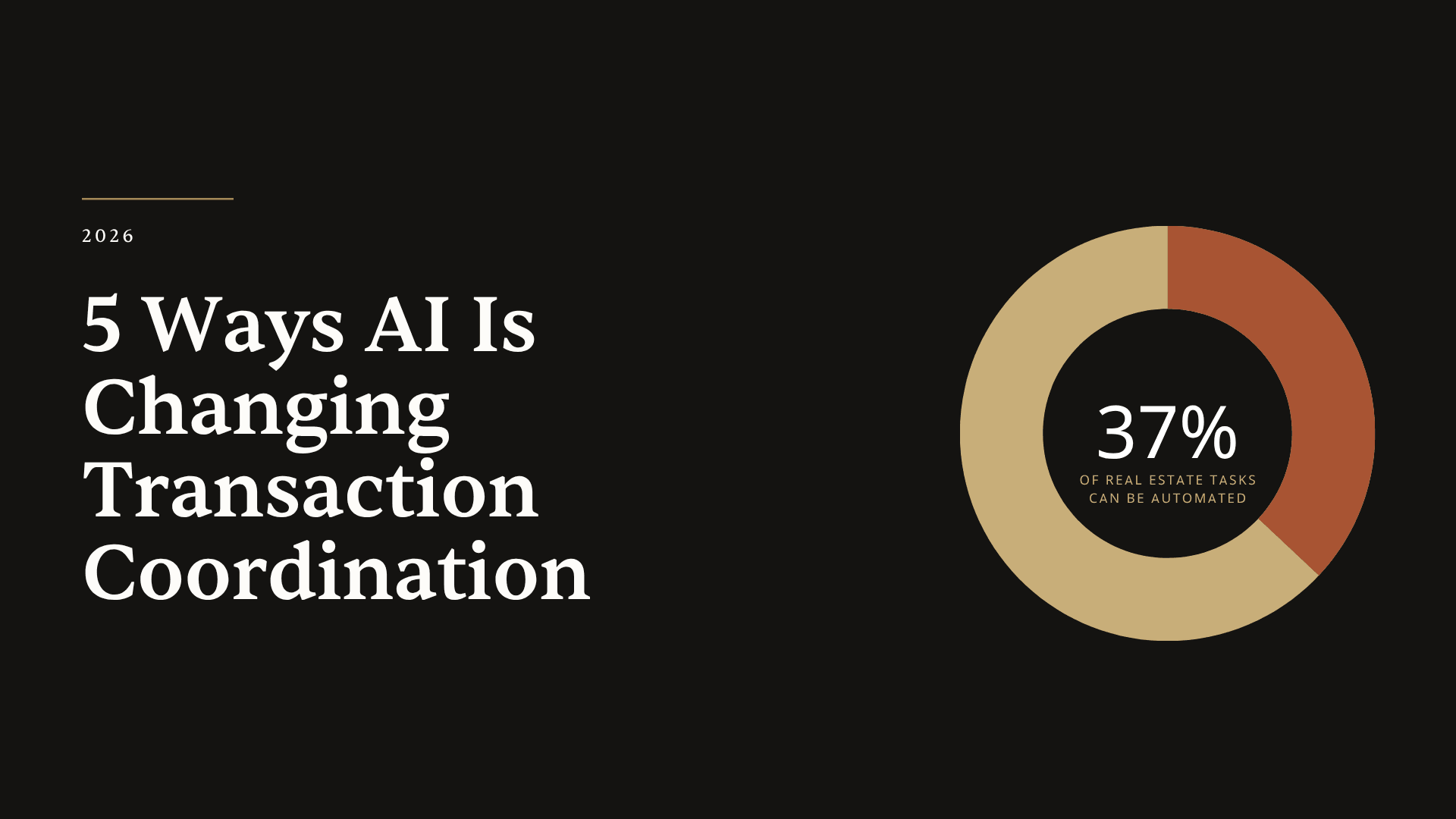
Morgan Stanley Research estimates that AI could deliver $34 billion in operating efficiencies to the real estate industry by 2030. Their analysis found that AI can automate 37% of tasks in real estate, with brokers and service providers seeing the highest potential gains.
For transaction coordinators specifically, the impact is even more dramatic. TCs using AI-powered automation report:
- 30% increases in productivity
- 40% fewer errors
- 70-90% faster document processing
Let's make that concrete. Say you're handling 15 transactions per month. Contract intake alone (reading the purchase agreement, entering all the data, calculating deadlines) typically takes 30-45 minutes per file. That's 7.5 to 11 hours monthly just on intake. Not managing transactions. Not communicating with clients. Just reading and typing.
With AI contract reading, that same intake takes about 60 seconds. The AI reads the document, extracts parties, dates, financials, and contingencies, and presents everything for your review. You verify the critical fields, approve, and the timeline gets built. Total time: a few minutes instead of 45.
Multiply that across 15 transactions and you've recovered 7-10 hours. What do you do with that time?
Some TCs take on more files. If intake was your bottleneck, you might handle 20 or 25 transactions instead of 15. At typical TC rates, that's significant additional income without working longer hours.
Other TCs use the time to provide better service. More proactive communication. Faster response times. The kind of attention that turns one-time clients into referral sources.
And honestly? Some TCs just use it to stop working evenings and weekends. To have dinner with their family. To remember why they started this business in the first place.
The capacity ceiling created by manual processes disappears. Your growth is no longer limited by how fast you can type or how many hours you're willing to work.
This is what Ava, ListedKit's AI assistant, is designed to do. When you upload a contract, Ava reads it in about 60 seconds and extracts all the key details. But here's what matters: she presents everything for your review before anything gets created. You scan through, verify the critical fields, approve, and then she builds the timeline and task list. Whether you're working with California PRDS forms, Texas TREC contracts, or Florida FAR/BAR agreements, Ava handles them without pre-setup. It's AI doing the tedious work while you stay in control of the accuracy.
4. The AI Productivity Gap: Why Falling Behind Gets Harder Every Month
Here's the uncomfortable truth about technology adoption: the gap between early adopters and everyone else compounds over time.
Two years ago, most real estate professionals were skeptical about AI. It seemed like hype, or at best a future possibility. That's changed dramatically. According to industry surveys, 97% of real estate professionals now show active interest in using AI. The skepticism has evaporated.
But interest and adoption aren't the same thing. And the firms that have moved from "interested" to "implemented" are pulling ahead fast.
Rechat's industry analysis predicts that "by the end of 2026, 80% of top producers will work entirely within AI-integrated ecosystems." Not using AI occasionally. Working entirely within AI-powered systems.
Think about what that means for competitive dynamics. If the top performers in your market are using AI to handle 15 transactions in the time it takes you to handle 10, they're not just more efficient. They're building more relationships, generating more referrals, and capturing more market share. Every month that gap widens.
The AI real estate market itself tells the story. It's projected to grow from about $2.9 billion in 2024 to more than $41 billion by 2033. That's not gradual adoption. That's an industry transformation.
For transaction coordinators, this creates both risk and opportunity. The risk: agents and brokerages will increasingly expect AI-powered service. Manual processes will start to look slow, error-prone, and frankly outdated. The TC who takes 45 minutes to process a contract will lose clients to the one who does it in 60 seconds.
The opportunity: there's still relatively little competition in the AI-powered TC space. As one of our customers put it, "You don't have any competition right now." The TCs who position themselves as tech-forward, AI-enabled professionals have a window to establish themselves before the market catches up.
That window won't stay open forever. But right now, adopting AI isn't just about efficiency. It's about positioning yourself for where the industry is clearly headed.
5. Human Skills That Matter More in an AI World
Here's the paradox that most AI discussions miss: as AI handles more tasks, human skills become more valuable, not less.
Think about what happens when AI takes over the mechanical work. The data entry, the deadline calculations, the routine communications. What's left? The parts of transaction coordination that actually require a human.
Relationship building. When a first-time buyer is panicking about their inspection results, they don't want to talk to an AI. They want someone who understands their anxiety and can walk them through their options with empathy.
Complex problem-solving. When three contingencies are expiring simultaneously and the lender just asked for documents that don't exist, you need human judgment to navigate the situation. AI can flag the problem. It can't solve it.
Reading emotional cues. Knowing when an agent is frustrated versus when they're about to walk away from a deal. Understanding that the seller's "minor concern" is actually a deal-breaker if not handled carefully. These require emotional intelligence that AI doesn't have.
Negotiation and advocacy. Representing your client's interests when multiple parties have competing priorities. Finding creative solutions that satisfy everyone. Building the trust that makes future deals happen.
A Zillow executive quoted by Inman put it perfectly: "AI should give agents time to go do the human stuff."
The same applies to TCs. When AI handles the 170+ discrete mechanical steps in a transaction, you have time and mental energy for the moments that actually matter. The conversations that save deals. The relationships that generate referrals. The judgment calls that separate good TCs from great ones.
The winning formula for 2026 isn't AI OR human skills. It's AI handling the mechanical work so humans can focus on the irreplaceable stuff.
How to Prepare: Your 2026 AI Readiness Checklist
Knowing AI is important is one thing. Actually preparing for it is another. Here's a practical roadmap for TCs who want to be ready for 2026.
Start with one AI-powered workflow. Don't try to transform everything at once. Pick one high-impact area and test AI there. Contract intake is usually the best starting point because it's time-consuming, repetitive, and has clear success metrics. If AI can read your contracts accurately and save you 30 minutes per file, you'll see the value immediately.
Audit your current process. Where are you spending time on tasks that don't require human judgment? Data entry, deadline calculations, routine email drafts, document organization. These are all candidates for AI assistance. Make a list of how you spend your time in a typical week, and identify which tasks are mechanical versus which require your expertise.
Test before you commit. Look for tools with low-risk entry points. Free first transactions, usage-based pricing, or trial periods let you evaluate whether AI actually works for your workflow before making a significant investment. ListedKit's pricing, for example, starts at $14.99 per intake with your first one free, so you can experience AI contract reading without commitment.
Understand the difference between automation and AI. Not every tool that claims to use AI actually does. True AI can handle documents it's never seen before, understand context rather than just matching patterns, and improve over time. Automation tools need pre-configured templates and fail on anything outside their programming. Our guide on AI vs automation for transaction coordinators goes deeper on how to tell the difference.
Build AI into your value proposition. As you adopt AI tools, update how you talk about your services. "AI-assisted transaction management" signals to agents and brokerages that you're tech-forward and efficient. The TCs who position themselves as AI-enabled professionals will attract clients who value efficiency and accuracy.
Stay informed but don't chase every trend. The AI landscape is evolving fast, and not every new tool will be relevant to your work. Focus on proven applications (contract reading, task management, email drafting) rather than experimental features. The goal is sustainable efficiency, not constant tool-switching.
The Bottom Line
AI is transforming transaction coordination in 2026, not by replacing TCs, but by removing the mechanical work that never required human intelligence in the first place. You didn't become a transaction coordinator because you love manual data entry. You became one because you're good at managing complexity, solving problems, and keeping deals on track.
The TCs who thrive this year will be the ones who let AI handle the data entry, deadline calculations, and repetitive tasks so they can focus on what actually matters: relationships, judgment, and getting deals to closing.
The shift is happening whether you're ready or not. The question is whether you'll be leading it or catching up.