Ai Automation
What If ChatGPT Already Knew Every Detail of Your Deals?
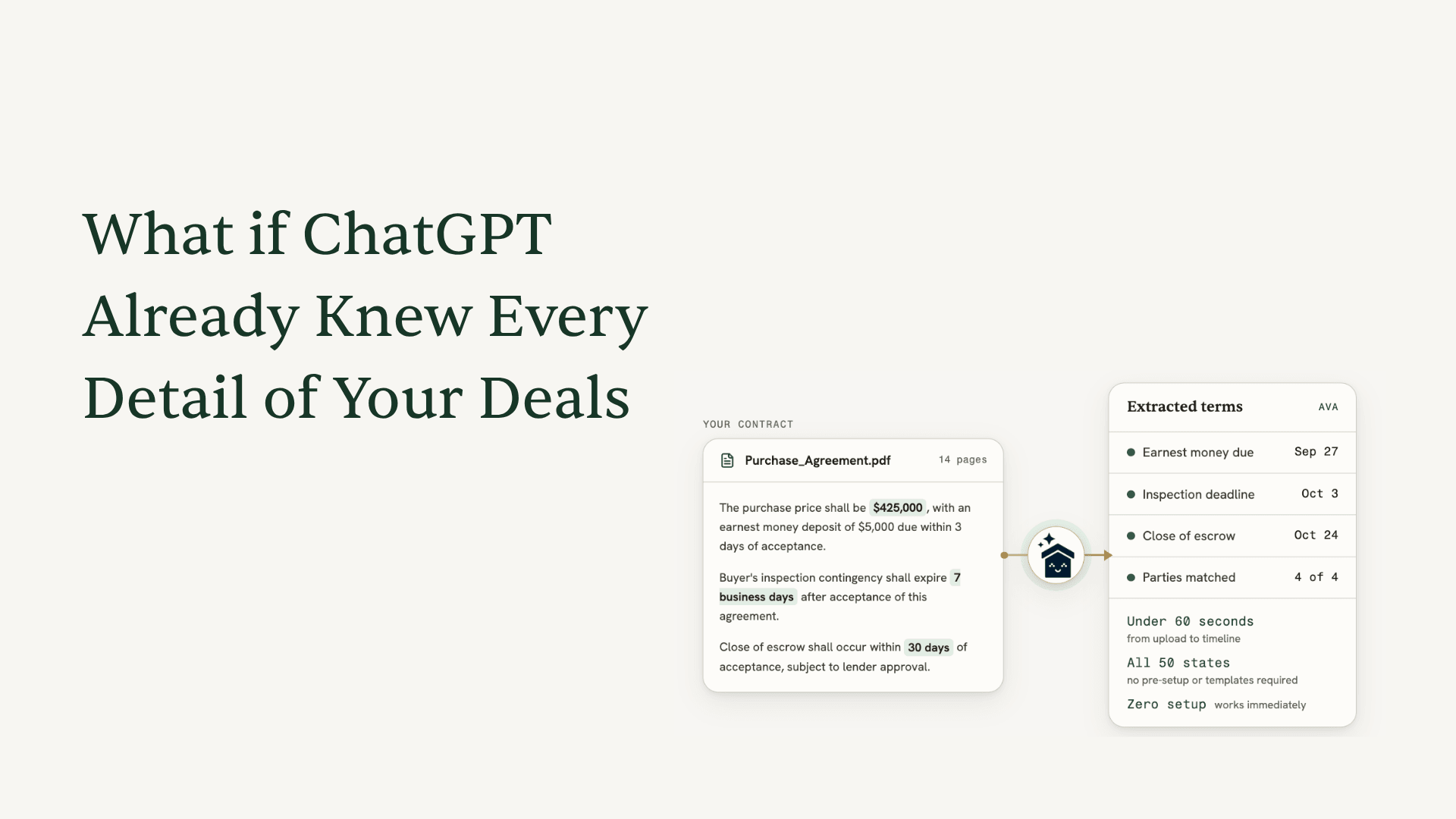
What would it look like if you could talk to an AI that already knew every contract you're working, every deadline coming up, every party involved, and exactly how you like to run your transactions?
You wouldn't have to copy-paste contract text into a chat window. You wouldn't have to explain what a financing contingency is or how to calculate "7 business days before closing." You wouldn't have to re-describe your process every single time you start a new deal. The AI would just know. Your deals. Your process. Your real estate knowledge. All of it, already loaded and ready to go.
That's the difference between using ChatGPT for transaction management and using AI that's actually built for it. And once you understand that difference, you'll never look at your workflow the same way.
ChatGPT Is Genuinely Powerful (Let's Be Honest)
Before we get into what's missing, let's give credit where it's due. ChatGPT is a remarkable tool for real estate professionals. It can write polished emails from a rough prompt. It can explain complex contract clauses in plain English. It can brainstorm solutions when you're stuck on a tricky negotiation. It can generate social media posts, listing descriptions, and marketing copy that would have taken you an hour to write yourself.
For $20 a month, that's real value. And plenty of real estate professionals are using it effectively for exactly those tasks.
But here's what happens when you try to use ChatGPT to actually manage a transaction. You open a new chat. You paste in some contract text. You ask it to pull out the key dates. It does a decent job, maybe. Then you ask it to calculate when the inspection deadline falls. It gives you an answer, but you're not sure if it accounted for weekends. You ask it to draft a welcome email to the buyer. It writes something generic because it doesn't know the buyer's name, the property address, or the closing date unless you type all of that in manually.
And then tomorrow, when you need to draft a deadline reminder for the same deal? You open a new chat. And you start explaining everything again from scratch.
That's the gap. Not capability. Context.
The Context Problem: Why "Smart" Isn't Enough
ChatGPT is one of the smartest AI tools on the planet. It can reason, write, analyze, and explain at a level that seemed impossible a few years ago. But intelligence without context is like hiring a brilliant new employee and never giving them access to your files.
Think about what you'd need to explain to ChatGPT every single time you want help with a deal:
- The buyer's name, seller's name, agents on both sides, lender contact, title company
- The property address, purchase price, earnest money amount
- The closing date, inspection deadline, financing contingency period, appraisal deadline
- Which counteroffer is the final one (and which terms changed at each step)
- Your state's specific requirements and timelines
- Your preferred process for this type of transaction
- What documents you still need and which ones have been received
- Which deadlines have passed and which are coming up this week
That's 20 minutes of typing before ChatGPT can even start helping you. And it evaporates the moment you close that chat window. According to Spellbook's analysis of ChatGPT for contract work, this lack of persistent context is one of the fundamental limitations: ChatGPT doesn't know your business, your risk posture, or your preferred positions. You can paste in a playbook, but it doesn't enforce it. It guesses how to apply it.
Now multiply this by 15, 20, or 30 active transactions. You'd spend more time feeding context to ChatGPT than you'd save by using it.
This isn't a knock on ChatGPT. It's a brilliant general-purpose tool being asked to do a specialized job without the information it needs to do it well.
What Changes When AI Already Knows Your Deals
Now imagine the opposite scenario. You upload a contract. The AI reads the entire document in 60 seconds, including handwritten fields, messy scans, and margin notes. It extracts every party, every date, every dollar amount, every contingency. It follows the logic across three counteroffers to figure out which terms are actually final. And it stores all of that in your transaction dashboard, connected to everything else.
This is what purpose-built transaction management AI does. And it fundamentally changes what's possible.
When you want to send a welcome email to the buyer, you don't explain who the buyer is. The AI already knows. You say "congrats, send timeline, spruce it up" and it drafts a polished email with the buyer's name, the property address, every key deadline, and a professional tone. Then it sends from your Gmail or Outlook. Not from some AI email address. From your actual inbox, with your signature. The recipient has no idea AI was involved.
When a deadline is approaching, you don't need to remember it. The AI already calculated "10 business days after acceptance" when it read the contract, converted that to an actual calendar date, and it's been tracking it ever since. It reminds you before things get urgent, not after.
When you need to check whether all required documents have been received for a California transaction vs a Florida deal, the AI knows the difference. It builds document checklists based on the state, the brokerage, and the transaction type. It checks documents for compliance issues: missing signatures, missing information, data that doesn't match between documents. Problems get flagged before they delay closing.
And here's the part that changes your daily workflow the most: you can just talk to it. Not "paste your contract text here and specify which fields you want extracted." Just talk. "What's the inspection deadline on the Johnson file?" "Draft an email to the listing agent about the appraisal coming in low." "Add the HOA task list to all my active transactions." The AI understands because it already has the context of every deal you're working.
This is what it feels like when AI actually understands your transactions instead of just understanding language.
The Accuracy Gap You Can't Afford to Ignore
There's another dimension to the context problem that matters a lot when you're dealing with real estate contracts: accuracy.
Research from Stanford University found that general-purpose AI models deviate from actual legal facts 69 to 88 percent of the time. That's not a typo. When ChatGPT interprets contract language without specialized training, it gets the legal nuance wrong more often than it gets it right.
And here's what makes that especially dangerous for transaction management: ChatGPT doesn't tell you when it's unsure. It delivers every answer with the same confidence, whether it's correct or hallucinating. LegalSifter's analysis puts it plainly: ask ChatGPT the same contract question twice and you might get two different answers.
When you're tracking 198 tasks across a real estate transaction, "might be right" isn't good enough. One wrong date calculation could mean a missed contingency. One incorrect party name in an email could undermine your professionalism. One overlooked counteroffer term could create a liability issue.
Purpose-built AI solves this differently. Instead of interpreting contract language through general knowledge, it reads the actual document and extracts the actual data. The closing date isn't a guess based on what closing dates usually are. It's the specific date written on page 3, paragraph 2 of your contract. And when there are counteroffers, it traces through each one to find the binding terms, not the superseded ones.
There's also the data privacy question. When you paste a real estate contract into ChatGPT, that information goes to OpenAI's servers. Industry experts consistently warn against uploading contracts with personal data, financial terms, or party identifiers to public AI tools. Purpose-built transaction platforms keep your data within a secure, dedicated environment.
The Onboarding Unlock: New Hires Productive on Day One
Here's where this really clicks for team leads and brokerage owners.
Think about what it takes to onboard a new TC or transaction coordinator assistant today. They need to learn your process. Your email templates. Your document checklists. Your state-specific requirements. How you handle counteroffers. When you send certain communications. What your agents expect. It takes weeks, sometimes months, before a new team member is truly independent.
Now think about what happens when your process, your templates, and your deal knowledge all live inside an AI that any team member can access from day one.
A new hire joins your team on Monday. By Monday afternoon, they're managing their first transaction. Not because they magically absorbed years of TC knowledge. But because when they upload a contract, the AI reads it. When they need to send an email, the AI drafts it with your templates and your voice. When they're unsure about a Texas vs New York requirement, the AI already knows the difference. When they need to build a timeline, it builds itself from the contract data.
Your process isn't trapped in your head anymore. It's in the system. And every team member, whether they've been with you for three years or three hours, has access to the same institutional knowledge.
This is something ChatGPT fundamentally can't offer. Not because it's not smart enough. But because it doesn't have your deals, your process, or your real estate context. Every new team member using ChatGPT starts from the same blank page. There's no institutional memory. No process documentation that the AI can actually use. Just a smart tool waiting to be told what to do, over and over again.
The Real Cost Comparison
Let's talk numbers, because this is where the "just use ChatGPT" argument falls apart.
ChatGPT Plus costs $20 per month. That's cheap. But you're still doing 20 to 30 minutes of manual contract reading and data entry per file. At 15 transactions a month, that's 5 to 7.5 hours of manual work that ChatGPT doesn't eliminate. It can help you write better emails about those transactions, but it can't read the contracts for you, build the timelines, or track the deadlines.
Purpose-built AI like ListedKit costs $14.99 per intake. At 15 transactions, that's about $225 per month. But those 5 to 7.5 hours of manual intake work? Gone. Contract reading, timeline building, task generation, email drafting; it all happens automatically.
So the real question isn't "$20 vs $150." It's "5 to 7.5 hours of your time vs $130." And if your time is worth more than $17 an hour (it is), the math works out clearly.
And that $150 scales linearly. At 25 transactions, it's $250 per month but you're saving over 12 hours of manual work. At 30 transactions, a TC doing everything manually is spending nearly 15 hours a month just on intake and data entry. That's almost two full working days every month spent doing work that a computer can do better and faster.
Plus, you can use both. ChatGPT for marketing copy, social media posts, brainstorming, and general writing. Purpose-built AI for the actual transaction work. They're complementary tools, not competing ones.
When to Use Each (The Smart Approach)
The smartest real estate professionals aren't choosing between ChatGPT and specialized tools. They're using both for what each does best.
Use ChatGPT when you need:
- Marketing copy, listing descriptions, social media posts
- Help explaining complex contract terms to a client in simple language
- Brainstorming solutions to unusual transaction situations
- General real estate knowledge or industry research
- Quick writing tasks that don't require transaction-specific data
Use purpose-built transaction AI when you need:
- Contract reading and data extraction
- Timeline building with automatic date calculations
- Deadline tracking across multiple transactions
- Email automation that sends from your own inbox with deal-specific details
- Document compliance checking (missing signatures, data mismatches)
- Team collaboration with shared processes and templates
- Onboarding new team members quickly
The rule of thumb is simple: if the task requires knowledge of your specific deal, use the tool that already has it. If it's a general writing or thinking task, ChatGPT is great.
The Bottom Line
The bottom line? ChatGPT is a brilliant AI that starts blank every time you open it. Purpose-built transaction management AI is a brilliant AI that already knows your deals, your process, and your real estate knowledge. The difference isn't intelligence; it's context. And in transaction management, context is everything. Your first intake on ListedKit is free, so you can experience the difference for yourself: upload a contract, watch Ava read it in 60 seconds, and see what it feels like when AI already knows your deal. Check pricing details here.