Best Practices
What Happens When Your Team Doubles and Your Systems Don’t
How do the fastest-growing real estate teams double their agent count in 60 days without their operations collapsing under the weight of it?
It isn't by hiring another transaction coordinator the moment things get tight. It isn't by pulling longer nights, or by asking the team lead to "jump in on a few files this week." The teams who actually scale fix the system before the next wave of agents comes in, not after. Scaling real estate team operations is a system problem, not a staffing problem, and the teams who survive the growth phase figure that out one quarter too early instead of two quarters too late.
This guide walks through what breaks first when a team grows too fast, the exact order things come apart, and the playbook to fix operations before the next 15 agents show up. It's written for brokers, team leads, and ops directors who can already see the next level and know the current setup won't carry them there.
The moment your system stops scaling with you
Kaley Tillery runs a mega team out of Seattle. She told us something we've now heard from half a dozen team leads on demo calls, almost verbatim:
"We doubled in 2 months. We're planning to triple. The tool has to grow with us."
That sentence is the whole problem in one line. Most of the tools a team lead picks when the team is 10 agents weren't designed for when the team is 30. They worked because the team was small enough that the humans could hold the gaps together. One admin knew where every file lived. The TC remembered what each agent liked. The team lead could still look over at the desk across the room and ask where the Johnson deal was at. That setup is fine at 10 agents, and it dies at 25.
The painful part is that the tools don't stop working in an obvious way. Nothing crashes. Nothing sends an alert. Instead, the tool just quietly stops being enough, and you only notice because the TC is tired, or because an agent called confused, or because a closing slipped by three days for a reason nobody can quite pin down. By the time you can name the problem, you've already lost a quarter trying to staff your way out of it.
Related reading: how real estate teams run 50 transactions without hiring a second TC.
What breaks first when a real estate team grows too fast
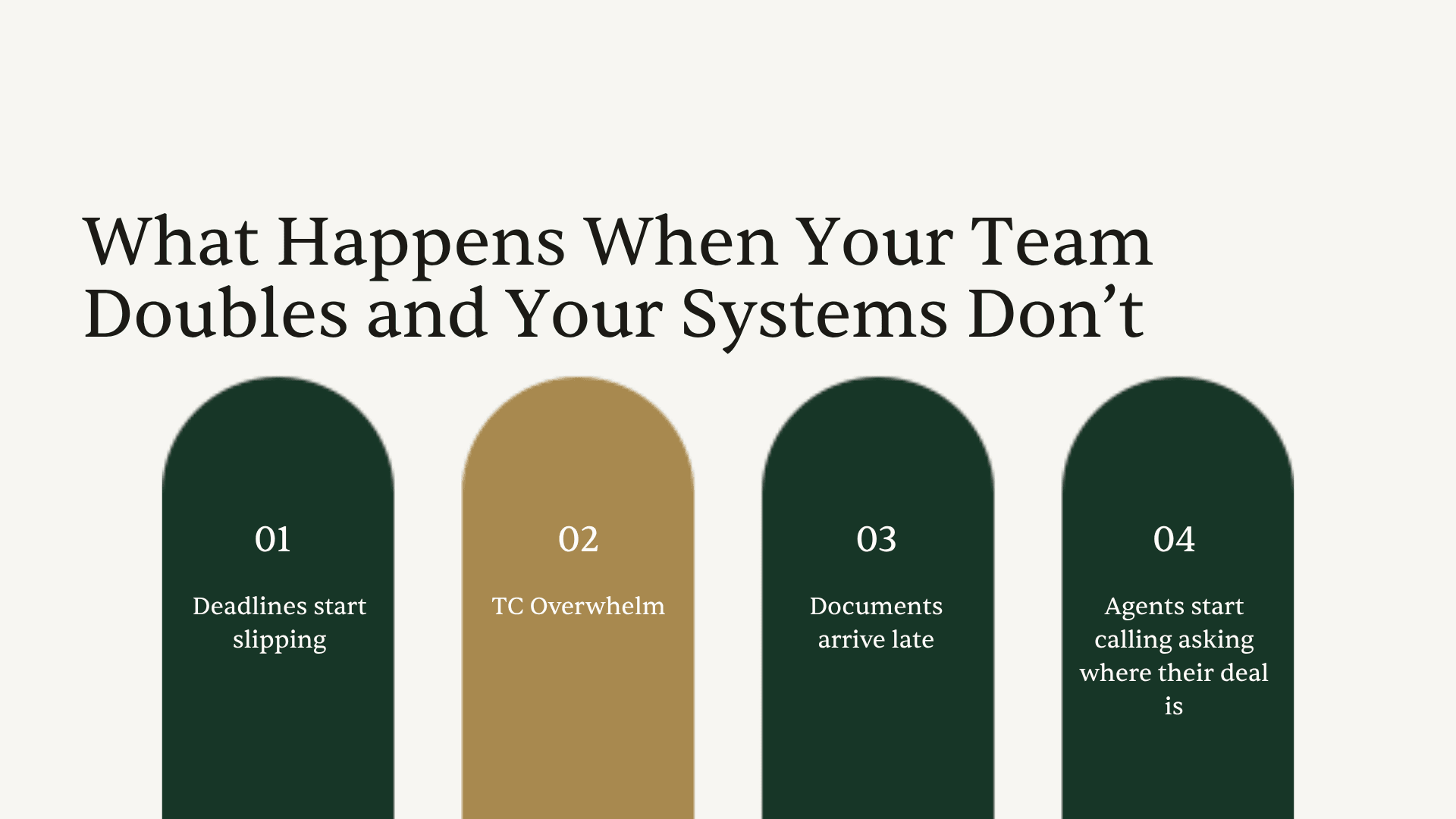
When a team grows too fast, operations break in a predictable order: missed deadlines first, then TC overwhelm, then documents arriving late, then agents calling the TC to ask where their deal is. Every team lead we've talked to has lived through some version of that exact sequence, usually in that order, usually within 90 days of a big hiring push.
Here's what each stage actually looks like on the ground.
Stage 1: deadlines start slipping. Not the obvious ones. The quiet ones. The inspection contingency that expired Monday instead of Friday because someone counted calendar days instead of business days. The loan contingency that nobody flagged because the file was buried behind seven newer ones. Your TC didn't get lazy. They got volume. According to industry capacity benchmarks, a TC without the right software handles around four transactions a month, and a seasoned TC with standard tools maxes out around 15 active files. At 30 agents closing twice a quarter each, the math doesn't survive contact with reality.
Stage 2: TC overwhelm. Lauren Johnson handles more than 300 files a year. Her real workload isn't the transactions themselves, it's the context-switching. Open Monday.com to check tasks. Jump to Follow Up Boss to find the client. Open Gmail to find the email thread the agent was asking about. Switch back to Monday.com because the tab got buried. Every one of those context switches costs a few seconds of attention. Across a 300-file year, that's entire working weeks of a sharp, experienced TC's attention burned on tool-hopping instead of the parts of the job that actually need them. The TC isn't the bottleneck. The workflow around them is, and it's wasting the person you most want to protect.
Stage 3: documents arrive late. Which means closing dates slip. Which means lenders flag the file. Which means the team lead now has to answer for something they never had visibility into in the first place. The risk here isn't just the closing, it's the liability. Your name is on the team. The mistake isn't the TC's, it's the system's, but the brokerage still holds the risk.
Stage 4: agents start calling to ask where their deal is. This is the one every team lead notices last, because agents are used to asking. It feels normal. It isn't. Every one of those calls is a piece of evidence that the file has no single source of truth, and that your team is now running on memory instead of process. The 2025 NAR Member Profile found that the most-used technologies among real estate professionals are still the MLS and e-signatures, which is another way of saying most teams are running transaction workflows on tools that were designed for individual agents. That gap, between agent-era tooling and team-era volume, is where operations break.
The 47-step problem
Misti Renteria runs operations for an 80-agent team in San Antonio. She described her intake process to us like this:
"47 steps just to go under contract, doing things in triplicate."
47 steps. In triplicate. That's what intake looks like when a team grows without rebuilding the system. Forty-seven things to check, enter, copy, verify, forward, or file, across three different tools, three different people, and three different formats of the same information. At 10 transactions a month, 47 steps is annoying. At 40 transactions a month, 47 steps in triplicate is a full-time job that nobody formally owns.
The pattern you see in every fast-growing team is that the steps don't get added on purpose. They get added because something went wrong once, and now there's a checklist item to prevent it. One slipped signature, a checklist item. One missed disclosure, a checklist item. One compliance violation, a checklist item. Nothing bad about that individually. But at volume, you end up with a process that's a monument to every past mistake, instead of a system that prevents the next one.
The teams that stop this spiral are the ones that move those checks into the system instead of onto the human. If Ava is reading the contract during intake and already extracted the parties, the property address, the closing date, the financing terms, and the deadlines, that's 20 of the 47 steps gone. Not because the steps stopped mattering, but because the system is doing them now, and doing them the same way every time. See also: automating real estate deadlines.
Triplicate doesn't scale. A single source of truth does.
How real estate teams scale operations without adding headcount
You scale operations by moving your TC out of the grunt work and into the review seat. That's the one-sentence version. Your TC's judgment is the thing that keeps deals together, and judgment doesn't scale if they're spending most of the day re-typing data from PDFs. Teams that scale well rebuild their operational stack around four capabilities before they hire the next wave of agents: contract intake the TC reviews instead of performs, deadline tracking the TC verifies instead of calculates, a single source of truth they drive from, and team-level visibility that surfaces what needs their attention.
Every one of those four keeps the TC in the decision-making role where their experience actually pays off, and it's how teams buy capacity without burning out the people doing the work.
1. Contract intake the TC reviews instead of performs. The single slowest task in any TC workflow is reading the contract and typing the key data into a system. Dates, parties, property info, financing terms, broker splits, contingency deadlines. A good TC does it in 20 to 30 minutes per file. A great one, maybe 15. None of that time is the part of the job that actually requires a TC's experience. The part that requires experience is catching the weird stuff: the counter that changes the financing type, the addendum that moved the closing date, the handwritten note in the margin that nobody flagged. When Ava does the first pass in under a minute, your TC opens the file and goes straight to the review work, where their expertise matters. ExpertVA's 2026 pricing breakdown puts contract-level TC time at $250 to $500 per file before benefits, which is a lot of money for data entry that your TC also finds the least interesting part of the job. Ava reads any state's purchase agreement, extracts the key terms, handles counteroffers, and works on handwritten contracts, and then your TC confirms or corrects. See how Ava reads contracts in 60 seconds.
2. Deadline tracking the TC verifies instead of calculates. The deadline calculation should be a function of the contract, and the TC's job should be verifying it's right. When Ava builds the timeline from the contract itself, inspection, loan contingency, disclosure deadlines, and closing date are all derived from the executed dates, in business days or calendar days by state. When a counter changes a date, the timeline updates and your TC sees the diff. The TC isn't redoing math, they're reviewing the work and flagging the ones that don't look right. That shift, from "calculator" to "reviewer," is what lets one TC confidently carry 30+ active files instead of 15.
3. A single source of truth your TC drives from. This is the one that quietly kills scaling teams. Your TC is in Monday, your agents are in Follow Up Boss, your docs live in dotloop or SkySlope, and the transaction context is trapped in email. Every agent who wants a status update has to be told by the TC, because nothing is pulling the state together in one place. Every handoff between TCs is a risk. When the contract, timeline, tasks, emails, and document status all live in one file, the TC stops being the glue holding four systems together and starts being the person actually running the deal. The system holds the context. They hold the judgment.
4. Team visibility that surfaces what needs the TC's attention. Team leads don't need a Monday standup to know which files are at risk, and a TC at volume doesn't need to manually triage every morning. They need a dashboard that surfaces the deals that need human eyes today, so the TC can spend the day on the files that actually need them instead of reading every file to figure out which ones do. ListedKit's team tools put that visibility in one place, so the TC's attention lands where it earns the most. The team lead gets the same view without making their TC put together a status update.
Those four capabilities, combined, don't replace the TC, they promote them. The grunt work goes to the system. The judgment, the review, the relationships, and the exception handling stay with the humans on your team, which is exactly where you want them.
Where Ava fits today (and where your TC still does)
Ava does the first pass. Your TC does the review. That's the split, and it's the one that actually changes scaling math for a growing team. Ava reads the contract, extracts every key detail in under a minute, builds the deadline timeline, and hands your TC a file that's already set up to be reviewed. Your TC opens it, confirms what's right, catches the stuff only experience catches, and moves on to the next file.
Everything a TC does well is still a TC job. The relationships with agents and clients, the judgment call on a messy counteroffer, the decision to escalate, the nuanced email to an upset buyer. Ava doesn't touch any of that. What Ava does handle: reading handwritten contracts, following logic across counters to find the final terms, calculating business-day versus calendar-day deadlines by state, drafting first-pass client emails from your Gmail or Outlook (no AI branding), and running an AI compliance check that flags missing signatures or information mismatches for the TC to review before closing.
It's usage-based at $14.99 per intake, and the first intake is free. If your team is about to double, the fastest thing you can do today is put one real contract through Ava and watch what your TC's day looks like when the first 20 minutes of every file are already done for them. Start free. See the full feature set and pricing.
The playbook: what to fix before the next 15 agents show up
Misti put it exactly right: "If we bring in 15 more agents..." That's the sentence that should be triggering the operations rebuild, not the one that comes after the 15 agents are already hired and things are already breaking. Here's the order of operations we'd recommend to any broker or team lead who can see the next hiring wave coming.
Audit intake first. Time your current TC on a single contract, from "contract received" to "transaction set up in the system with timeline built and tasks assigned." If that number is above 30 minutes, that's your single biggest capacity lever, and it's the easiest to fix. Automated contract intake eliminates the first bottleneck and buys the TC roughly 10 to 15 hours a month back, depending on volume.
Consolidate the stack. Make a list of every tool currently involved in a single transaction, from contract to close. Email, task management, CRM, document storage, compliance tool, calendar. Count the handoffs. Every tool in that stack is a context switch, and every context switch costs attention. Consolidation doesn't always mean ripping things out, but it does mean identifying the one tool that is the single source of truth for the transaction itself. Everything else should be feeding that.
Set up team-level visibility before you need it. If the team lead or ops director can't answer "which of my deals are at risk this week?" in under 30 seconds, that's the next thing to fix. Not because the team lead needs to be in every deal, but because the risk of not being able to see them shows up later, and usually on the worst possible file.
Formalize the intake process before onboarding new agents. New agents bring new transactions. New transactions, in an unfixed system, break it faster. A documented intake, with the contract flowing through Ava, the timeline building in the background, and the TC reviewing and approving before anything goes out, is the version that survives onboarding 15 new agents. The TC stays the gatekeeper. The system just stops making them do the parts that don't need a human.
Pick a capacity target, then stress-test it. Pick a number. "Our team TC should handle 40 transactions a month by end of next quarter." Now, look at the current stack and ask honestly whether 40 is possible without burnout. If the answer is no, you know where the investment goes next.
The teams who do this in the right order absorb growth. The teams who do it in the wrong order, or not at all, burn out their TC, lose a couple of deals, and spend the next two quarters trying to recover.
Bottom line
Your team can absorb the next 15 agents, or it can break under them, and the difference comes down to whether you fix the system before they arrive. Scaling real estate team operations isn't about doing less TC work. It's about making sure the TC you already have is spending their day on the part of the job that actually needs them. Staff your way through it and you've bought six months. Move your TC into the review seat and you've bought the next three years.
Your first intake on ListedKit is free. Run one real contract through Ava today and see the intake math change in front of you. Get started free.
---