Best Practices
Attorney Review Period: What to Coordinate While You Wait
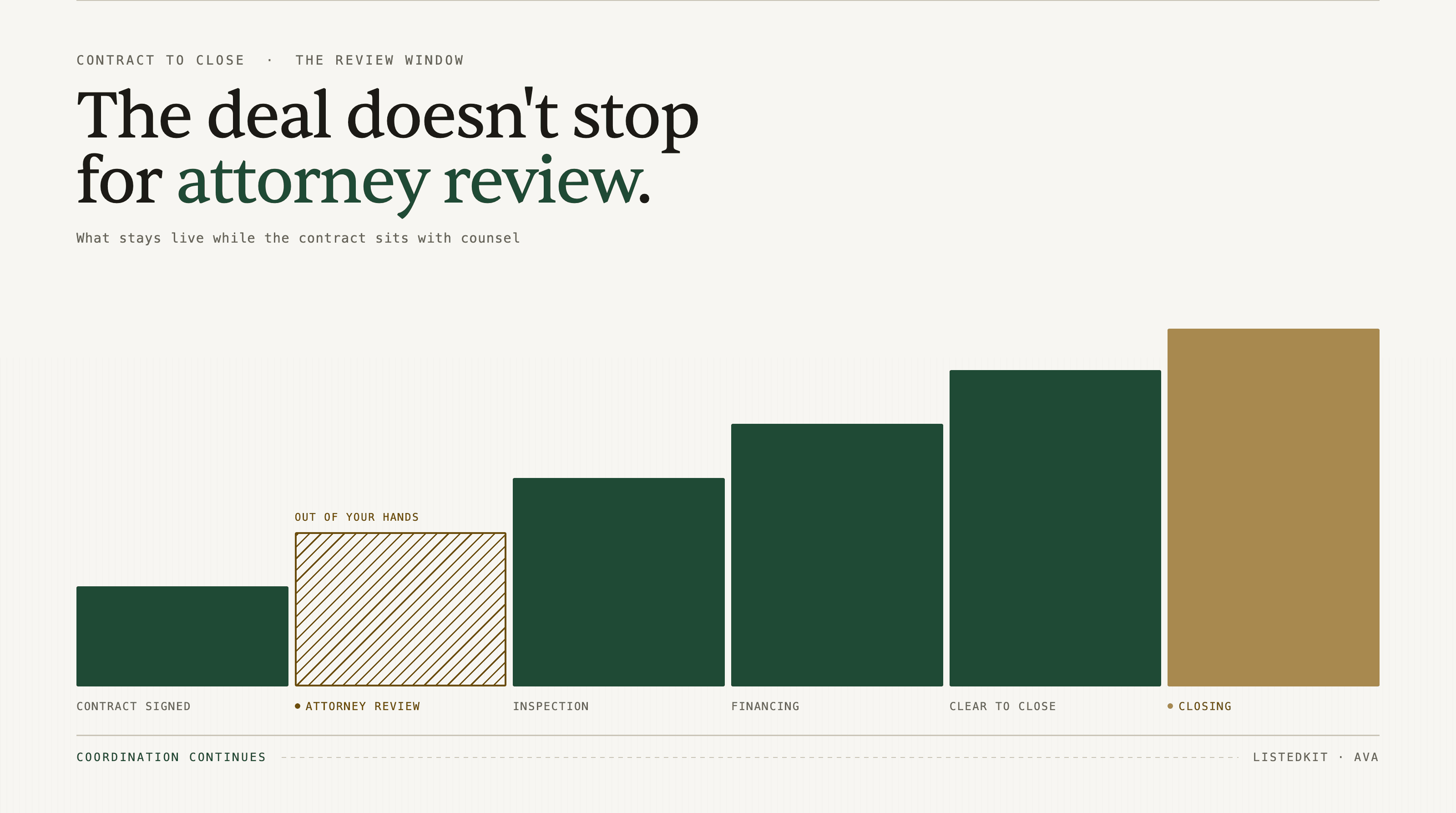
How long does attorney review take? It varies, and that is the honest answer. It depends on your state, on the contract in front of you, and on how many rounds of changes the two sides trade before they agree. What does not vary is this: the deal you hand off on Tuesday should not be the same deal you pick back up on Friday.
This article is about the coordination job during that window. Not what the lawyers are doing, that is theirs, but what has to keep moving on your side so the file is ready to run the moment review clears. Get this right and the review window costs you nothing. Get it wrong and you lose a week you never budgeted for.
The quiet stretch is where deals go sideways
Contracts do not usually fall apart in one dramatic moment. They erode.
In the National Association of REALTORS® REALTORS® Confidence Index for July 2026, published August 11, 2026, agents reported that 12% of contracts had a delayed settlement in the previous three months, and 6% were terminated outright. Those figures have held roughly steady month over month and year over year, which tells you something important: this is not a market condition, it is a process condition. Roughly one deal in eight is closing late in any given quarter, and the causes are ordinary.
Attorney review creates a structural version of that risk, because it is one of the few stretches in a transaction where the person holding the ball is not on your team. You cannot call the other side's attorney and ask them to hurry. You cannot see their queue. All you control is everything else, and "everything else" is a much longer list than most files treat it as.
What attorney review is, from the coordination seat
The legal substance of attorney review belongs to the attorneys. What they examine, what they can change, how long they have, and what happens if they disapprove are legal questions with state-specific and contract-specific answers. Your attorney and your broker are the source of truth for the file in front of you, not an article.
What is fair to say generally: attorney review is a window after a contract is signed during which the parties' attorneys examine the agreement and may propose changes. In practice, guides from attorneys in New Jersey and Illinois describe a short window, often counted in business days, that can extend when either side proposes modifications and the other responds. The reviewing attorney typically looks at things like inspection scope, mortgage and appraisal terms, title and survey provisions, the closing date, and deposit handling, as one summary of the review period lays out.
Notice what is on that list. Almost every item an attorney can touch is an item that changes your timeline.
The mistake: treating review like a pause button
When an agent tells a client "we're in attorney review," the client usually hears "nothing happens until it comes back." A surprising number of files get run the same way.
That reading is wrong, and it is wrong in a way that is easy to miss, because whether other clocks keep running genuinely depends on the contract and the market. In some markets, inspection and financing windows run concurrently with the review period, so the buyer is already on a clock the day the contract is signed. In others, the contract is not treated as fully executed until the attorneys finish, and the due diligence clock starts later. Both patterns are real. Which one applies to your file is a question for the attorney on the deal and your broker.
Here is what does not change between those two worlds: the coordination job is identical. For this specific file, you need to know three things at all times.
- Which dates are running right now.
- Which dates are contingent on review clearing and have not started.
- Which dates will have to be recalculated if the attorneys change the contract.
If you cannot answer all three in under a minute, the file is not being coordinated, it is being stored.

Four things that stay live during the window
1. The dates that are already running
Every transaction has some obligations that attach at signing regardless of what the attorneys are doing. Earnest money delivery is often one. Attorney designation and notice requirements can be another. Depending on the contract, inspection scheduling may already be on the clock.
The failure mode is subtle. A coordinator marks the file "in attorney review" as a status, the status becomes the mental model, and a live deadline sits underneath it unnoticed for four days. Nobody misses it on purpose. They miss it because the file looked parked.
The fix is to keep dates and status as separate things. Status describes where the contract is. The timeline describes what is owed and when, and it should stay visible and unchanged by status. If your system buries the timeline the moment a deal enters a holding state, that is a system problem worth fixing before it costs you a deal.
2. The documents that need to move
Review is not a reason to stop collecting. It is usually the best time to collect, because everyone involved is paying attention to the deal and nobody is yet in closing-week panic.
Realistically, this is the window to chase the seller disclosure package, confirm the buyer's pre-approval letter is current and matches the contract terms, get the earnest money receipt in writing, request the HOA or condo document order if the property has an association, and confirm which title company or closing agent both sides are using. None of that depends on the attorneys signing off. All of it becomes a bottleneck later if you wait.
Document collection is also the piece most likely to sit half-finished, because the requests go out by email and the responses come back scattered across three threads and two people. Our own platform data speaks to the volume here: teams have processed 60,730 transaction documents through ListedKit, with 37,031 of those in a single trailing 90-day window (ListedKit production database, April 2026). That is the shape of the real job. It is not one big document, it is a constant stream of small ones arriving in the wrong place.
3. The people who need to know where things stand
The number of parties on a modern residential deal is genuinely large. Buyer, seller, both agents, both attorneys, the lender, the title company, the inspector, sometimes an HOA manager. Ava has coordinated 34,176 parties across transactions on the platform (ListedKit production database, April 2026), which averages out to a lot of people per file who each need a slightly different version of the same update.
During review, the update most of them need is short: here is where the contract stands, here is what I need from you, here is what happens next. The value of sending it is not politeness. It is that a party who has heard from you in the last three days will answer your next email in hours instead of days, and when review clears you are going to need answers in hours.
The failure mode here is the coordinator who goes quiet because there is "no news." Silence during review is read by clients as a problem, and it generates exactly the kind of anxious inbound calls that eat the day you should be spending on the next file.
4. The work that has to be ready the day review clears
This is the one that separates a coordinator from an administrator.
When review ends, a set of things fire at once. The clock starts on windows that were waiting. Notices go out. Orders get placed. The question is whether you spend that day executing, or whether you spend it figuring out what to execute.
Everything on that day-one list can be staged in advance: the inspection contingency and financing deadlines calculated from the effective date, the introduction email to the lender and title company drafted, the client's next-steps email written, the task list built out to closing, the calendar entries prepared. Staged work is not wasted work even if the contract changes, because a changed contract usually means shifting dates on a plan that exists, which is a ten-minute job, rather than building a plan from scratch, which is not.
When review changes the contract, your timeline changes with it
This is the part that actually breaks files.

Attorney review frequently ends with a rider, an addendum, or an amendment. Sometimes it is minor language. Sometimes it moves the closing date, which cascades into every date you calculated backward from closing. If you are working from a checklist you built by hand on day one, you are now re-deriving that entire timeline, on a deadline, from a document that arrived as a PDF attachment in a thread with fourteen replies. That is where dates get dropped, and it is worth knowing the difference between the instruments that can do it, which we covered in addendum vs. amendment in real estate.
This is the specific problem Ava was built to absorb. She reads incoming email and attachments as they arrive, matches them to the right transaction, pulls out the dates and the parties, and updates the timeline rather than making you rebuild it. A Transaction Manager put it plainly in a G2 review: "I love the thinking done for you. One of my favorite functions is the auto moving of dates when an addendum is updated. I love that it pulls all contact information from email."
That is the whole mechanic. The amended contract arrives, the dates shift, the checklist reflows, and the coordinator reviews the change instead of reconstructing it. Across the platform, Ava has read 5,629 contracts, auto-extracted 40,838 fields from them, and tracked 48,066 transaction deadlines (ListedKit production database, April 2026). You can see how the contract reading works on the AI contract review page, and how the inbox side works in inbox monitoring.
One thing to be clear about: Ava works your side of the table. She works with agents, brokers, transaction coordinators, and admins on the deal. She does not contact the attorneys, does not participate in their review, and does not manage their process. The legal work stays entirely with counsel. What Ava does is make sure that when their work lands in your inbox, the file absorbs it immediately instead of waiting for you to have a free hour.
If you want to see that on a live file, your first transaction is free, so you can put a real deal through the review window and watch what the timeline does when an amendment shows up.
A shared live file beats a status update
The deeper problem with the review window is that the deal's true state lives in one person's head and one person's inbox. The agent asks the coordinator. The coordinator checks three threads. The client asks the agent. The agent asks the coordinator again.
That works at low volume and collapses at high volume, which is why static checklists tend to fail the people who need them most, a pattern we broke down in why static checklists fail transaction coordinators. A file that everyone can open and read for themselves removes an entire category of work: the work of telling people things.
For an attorney-review deal specifically, a shared timeline means the agent can answer their client without calling you, the lender can see when their window opens, and you can see at a glance which of your files are parked and which have live dates underneath a parked status. If you want the mechanics of keeping those dates accurate as things move, we covered that in automating real estate deadlines, and the sharing side is on the shared timelines page.
The broader case for running coordination this way, across every file rather than just the complicated ones, is on our page for transaction coordinators.
The bottom line
Attorney review is not dead time, and how long it takes is largely not your problem. What is your problem is whether the file is warm when it comes back.
Keep the running dates visible even when the status says "in review." Collect the documents that do not depend on the attorneys, which is most of them. Send the short update that keeps every party responsive. Stage the day-one work so that clearing review is an execution day, not a planning day. And make sure that when the amended contract lands, your timeline updates from it rather than waiting on you to notice.
A file coordinated that way closes on the original date. A file that sat for a week becomes one of the 12%.